Cold Outreach Automation That Actually Scales, The Analytics Framework by Industry
Adrian NguyenJuly 8, 202612 min read
Cold outreach automation is easy to start and surprisingly hard to scale, because most teams optimize activity metrics instead of pipeline outcomes. If you want volume without wrecking deliverability, you need a measurement-first success model that tells you, by industry, what “good” looks like and which signals predict meetings and revenue.
Key takeaways
Define success as a pipeline model (qualified replies, meeting velocity, and closed-won attribution), not opens and clicks.
Use an industry scorecard that separates deliverability, engagement, reply quality, and conversion so you can scale safely.
Run weekly optimization loops with guardrails (bounce, spam, negative replies) to increase volume without harming domain health.
A measurement-first framework for scaling outbound safely by industry.
Cold outreach automation only works when you define the success model first
The pain point is predictable: you automate sequences, increase send volume, and see “good” open rates, but meetings do not rise. The usual reason is that the success model is undefined, so you optimize what is easiest to measure.
Why activity metrics mislead, especially by industry
Open rate is inflated by security scanners and link preview tools. It is a weak proxy for intent.
Raw reply rate can be inflated by “unsubscribe” replies, out-of-office messages, or vendor gatekeeping.
Clicks are often low in cold email by design, because many strong cold emails do not include links.
Instead, define success as a chain of outcomes you can attribute to a sequence: Delivered → Human engaged → Qualified reply → Meeting booked → Opportunity created → Closed-won.
A 4-layer success model you can implement in a day
Engagement: human opens/clicks where available, but treated as directional only.
Reply quality: classify replies into qualified, neutral, negative, unsubscribe, and OOO.
Pipeline outcomes: meetings booked, show rate, SQL creation, and closed-won attribution to the first sequence touch.
Industry-specific “what good looks like” benchmarks (starting points)
Benchmarks vary by list quality, offer maturity, and brand. Use these as initial guardrails, then replace with your own baselines after 2 to 4 weeks of consistent sending.
B2B SaaS (mid-market): qualified reply rate 1.0% to 3.0%; meeting booked rate 0.3% to 1.0% of delivered.
Agencies and services: qualified reply rate 1.5% to 4.0% when targeting is tight; negative replies can spike if your positioning is vague.
Recruiting and staffing: reply rate can be higher, but qualified intent is noisy; strict reply classification is mandatory.
Industrial and manufacturing: lower reply rates are common; meeting velocity is slower, so measure “meaningful back-and-forth” as an intermediate milestone.
Real estate and local B2B: list accuracy drives everything; bounce and complaint thresholds should be stricter than your global average.
Once you define the model, cold outreach automation becomes an engineering problem: instrument, measure, iterate.
The industry analytics scorecard for cold outreach automation
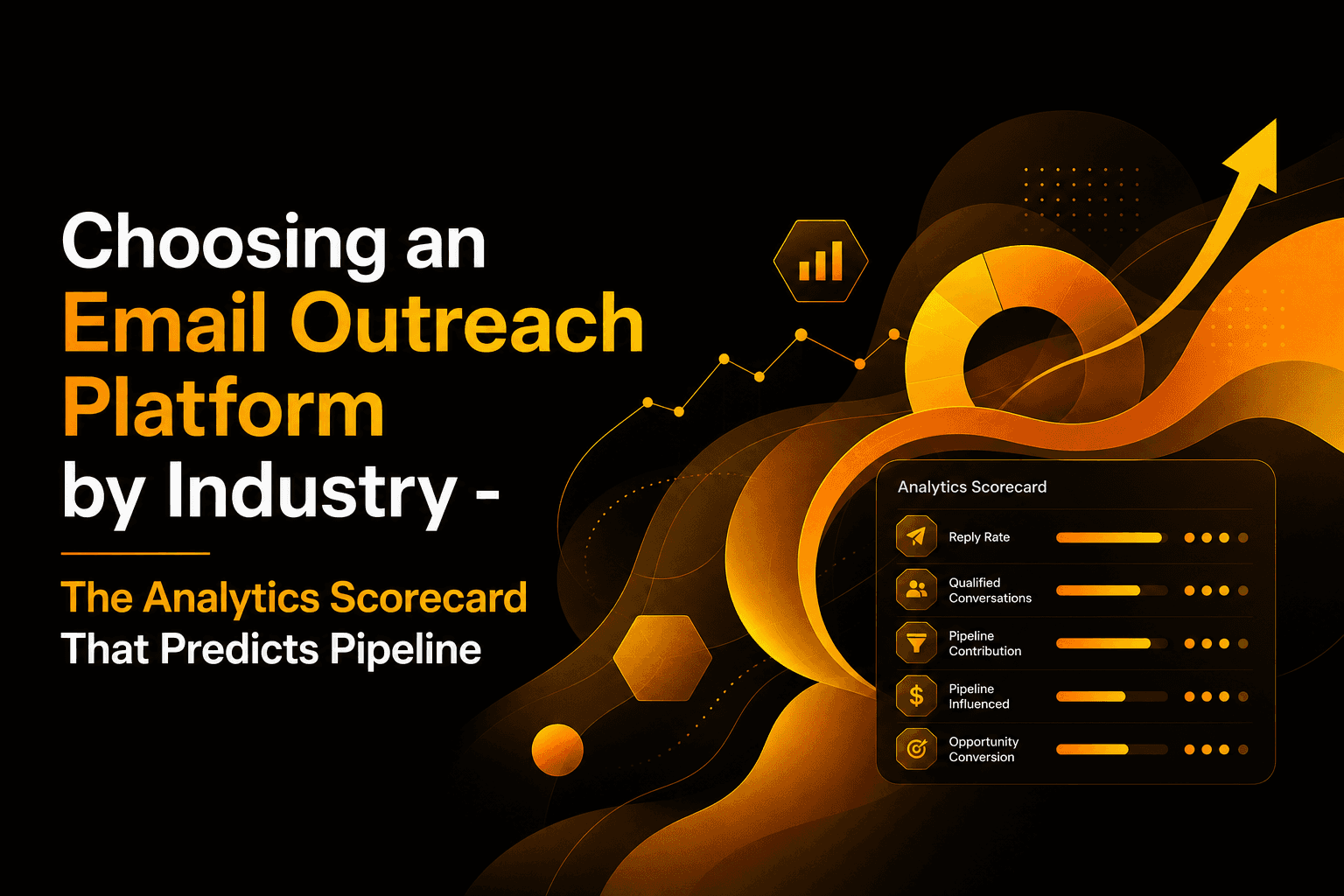
A scorecard keeps you from chasing a single metric. The simplest version that still predicts pipeline has four categories: deliverability, engagement, reply quality, and conversion. Track them by industry segment and sequence version (copy + offer + targeting rules).
Scorecard metrics (compact, high signal)
Deliverability
Bounce rate (hard + soft), by domain and by list source
Spam complaint rate, if available
Block or deferral events from your sending infrastructure
Engagement
Unique open rate, treated as directional
Human click rate (only if you use links), filtered for bots where possible
Negative reply rate (not a fit, annoyed, “stop emailing me”)
Unsubscribe rate (separate from negative)
OOO rate (useful for timing and follow-up rules)
Conversion
Meeting booked rate (per delivered)
Meeting held rate (show rate)
Opportunity creation rate and closed-won attribution
Industry scorecard targets and guardrails (use as thresholds)
Set two numbers per metric: a target (what you want) and a guardrail (when to pause or reduce volume). Example thresholds you can start with:
All industries: hard bounce guardrail at 2.0% per send day; if you hit it, stop and fix list hygiene.
Compliance-sensitive industries (finance, healthcare): negative reply guardrail tighter, because complaints can rise quickly if the message feels too aggressive.
High-churn inboxes (recruiting, staffing): OOO and “not me” replies are common, so route for role-based retargeting rather than counting as failure.
A simple “score” that correlates with meetings
If you need one number per sequence to compare industries, use a weighted score:
Sequence Health Score = (Qualified Reply Rate x 4) + (Meeting Booked Rate x 8) - (Hard Bounce Rate x 5) - (Spam/Complaint Proxy x 10)
Weights are intentionally opinionated: meetings matter most, deliverability failures are heavily penalized. Customize weights once you have 4 to 8 weeks of data.
Instrumentation blueprint for cold outreach automation analytics
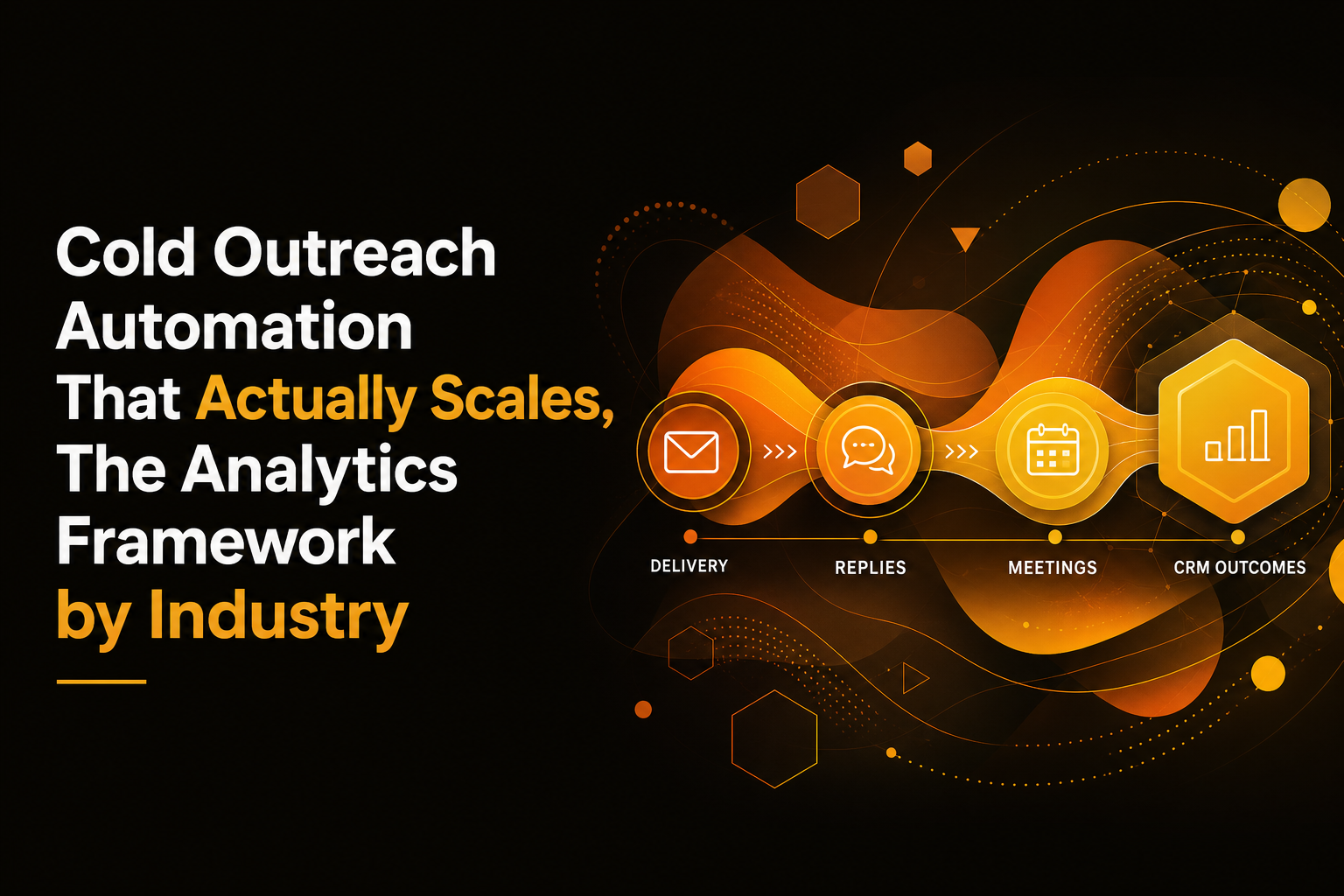
You cannot optimize what you cannot reliably attribute. The goal is end-to-end tracking from send event to CRM outcome, with consistent IDs so you can answer: “Which sequence version produced qualified replies and meetings in this industry segment?”
Event map checklist (what to log)
Prospect identity: email, company domain, industry tag, persona tag, list source.
No stable IDs: replies are stored in inboxes, meetings in calendars, and outcomes in CRM, but nothing ties them together.
Industry tagging is inconsistent: “Fintech” vs “Financial Services” becomes impossible to compare.
Reply quality is manual: too slow and inconsistent to be useful at scale.
Practical setup that works with most stacks
Email sending: ensure every outbound email includes a hidden or logged campaign identifier (most platforms store this internally).
Calendar: connect booking events so a meeting can be attributed to the contact and sequence.
CRM: write back key fields: last sequence touched, first-touch sequence, reply classification, and meeting outcome.
Enrichment: append industry and persona fields before sending, not after, so segmentation is clean.
For deeper measurement design, keep a lightweight reference of what each metric means and when to trust it. This guide on email analytics can help standardize definitions across your team.
Instrumentation map from delivery and replies to meetings and CRM outcomes.
Optimization loops that scale volume without killing domain health
Cold outreach automation fails when scaling is treated as “turn the volume knob up.” Safe scaling is a weekly loop: diagnose, experiment, and increase volume only when guardrails are stable.
The weekly loop (60 to 90 minutes, repeatable)
Segment the data: by industry, persona, and sending mailbox.
Check guardrails first: hard bounce, negative replies, unsubscribe, and spam signals. If any are above guardrail, pause scaling.
Pick one lever to test per segment:
Targeting: tighten industry subsegment or persona
Offer: change the call to action to match buying motion
Copy: adjust the first line hook and proof point
Cadence: change follow-up spacing, not just count
Run an A/B test with minimum sample: aim for at least 300 to 500 delivered per variant before calling a winner in most B2B contexts.
Scale in steps: increase daily sends per mailbox by 10% to 20% only if guardrails hold for 5 business days.
Deliverability guardrails you can operationalize
Hard bounce rate: keep below 2.0% per day; investigate list source and verification if it rises.
Negative replies: if negative replies exceed qualified replies for a segment, your targeting or positioning is off.
Unsubscribes: rising unsubscribes with flat qualified replies usually means your message is too broad.
If you need a concrete operating system for keeping reputation stable, reference a weekly routine to improve email deliverability while you scale.
Example optimization by industry
B2B SaaS: If opens are stable but qualified replies are low, test a more specific trigger (recent hiring, new integration, funding) and a tighter CTA (15-minute fit check).
Agencies: If replies are high but meetings are low, your CTA may be too big. Test “send 2 examples?” before asking for a call.
Manufacturing: If meetings are slow, track “requested spec sheet” or “asked for pricing range” as intermediate qualified intent.
Common failure modes by industry and the metrics that catch them early
This is where analytics pays for itself: you catch leading indicators before pipeline drops. Below are common patterns and the first metric that usually moves.
B2B SaaS failure modes
Problem: Over-personalized intros that do not connect to a clear pain.
Catches early: qualified reply rate flat while neutral replies rise (“Thanks, not a priority”).
Problem: Too many links or heavy HTML.
Catches early: deliverability dips and deferrals increase; open rate becomes erratic.
Recruiting and staffing failure modes
Problem: Lists decay fast; roles change weekly.
Catches early: hard bounce rate and “not here anymore” replies spike.
Problem: High reply volume but low intent.
Catches early: reply rate up, qualified reply rate flat; requires strict classification.
Agencies and professional services failure modes
Problem: Vague positioning (“We help you grow”).
Catches early: negative replies increase with “How did you get my email?” style responses.
Problem: Poor industry segmentation.
Catches early: high variance in qualified replies across subsegments; one niche works, others fail.
Industrial and regulated industries failure modes
Problem: Longer buying cycles misread as failure.
Catches early: meetings lag; track leading indicators like “requested documentation” or “forwarded internally.”
Problem: Compliance and procurement friction.
Catches early: qualified replies exist but meeting booked rate is low; adjust CTA to “who owns this?” instead of “book a call.”
If you are still building the fundamentals of targeting, copy, and sequencing, this deeper guide to cold outreach can help you reduce negative signals before you scale automation.
How to operationalize this with an AI agent, without losing control
The goal is not “hands-off.” The goal is consistent execution with governance. Cold outreach automation powered by AI can help you move faster, but only if you define approvals, guardrails, and reporting cadence.
Governance checklist for AI-assisted outbound
Targeting approvals: lock ICP fields (industry tags, employee count, geo) and require approval to expand.
Personalization QA: sample 20 to 50 emails per sequence version for factual accuracy and tone before scaling.
Guardrail automation: auto-pause when bounce or negative signals exceed thresholds.
Reply routing: qualified replies go to a human within SLA; negative and unsubscribe are handled consistently.
Weekly reporting: one page per industry segment with scorecard metrics and the next experiment.
What “control” looks like in practice
Use AI to do the repetitive work and humans to set constraints:
Humans define the industry scorecard targets and guardrails.
AI drafts and iterates copy based on what is producing qualified replies, but changes are reviewed before rollout.
AI helps classify replies and keep analytics clean so you are not optimizing on noise.
Tooling note
No single tool is required, but your stack must connect sending, reply classification, calendar outcomes, and CRM stages. If you are evaluating options, use an industry-oriented checklist like this guide to choosing an email outreach platform so you do not lose attribution once volume increases.
Metric category
What to track
Early warning signal
First fix to try
Deliverability
Hard bounce %, blocks/deferrals
Hard bounces > 2% on a send day
Verify emails, tighten list source, reduce volume temporarily
What metrics matter most for cold outreach automation?
Prioritize qualified reply rate, meeting booked rate, and deliverability guardrails (hard bounces and complaint proxies). Opens and clicks are directional only and should not be your primary success criteria.
How do I define a “qualified reply” consistently across industries?
Use a rule-based definition: interest, relevant questions, pricing or demo requests, or a clear handoff to the right owner. Exclude out-of-office, unsubscribe requests, and generic “not now” replies unless they include a concrete next step.
How fast can I scale send volume safely?
Scale in steps of 10% to 20% per mailbox per week, only after 5 business days with stable guardrails. If hard bounces rise toward 2% or negative replies spike, pause scaling and fix list quality or targeting first.
How do I attribute meetings and revenue back to a sequence?
Ensure each prospect has stable identifiers across your sender, calendar, and CRM. Log sequence name and version on the contact record, then write meeting booked and opportunity outcomes back to that same record so reporting can group results by industry segment and sequence version.
If you want to put this measurement-first approach into practice faster, Outbound Glow is built to help teams run cold outreach automation with cleaner analytics, qualified-reply focus, and deliverability guardrails so you can scale what works without guessing. Book a demo or start a trial, then implement the scorecard and weekly loop above as your operating system.
Adrian Nguyen
Adrian Nguyen is an expert on automation, SEO and AI fields.
Let's help his spread the words.