
Cold Outreach, Explained: A Practical System to Get Replies Without Burning Your List (2026)
Learn cold outreach end-to-end: targeting, messaging, follow-ups, and automation benefits. Use this system to get replies without damaging your domain.

Cold outreach fails for most small teams for one simple reason: they treat it like a one-time message blast instead of a repeatable system that protects reputation, stays relevant, and earns replies. If you have ever sent 200 emails, got a handful of opens, and then watched replies flatline, you already know the pain. This guide breaks cold outreach into a practical framework you can run weekly: define who to contact, write messages that sound human, follow up without being annoying, and measure what actually moves meetings.
Key takeaways
Cold outreach works when you treat it as a weekly system: targeting, message, follow-up, measurement.
Your biggest lever is relevance: one clear segment, one clear problem, one clear next step.
Automation should protect quality and consistency, not increase volume blindly.
What Is Cold Outreach?
Cold outreach is the process of contacting people who have not interacted with your business before, using a short, relevant message that asks for a specific next step (usually a reply, referral, or meeting). It helps founders and small teams start conversations with potential customers without waiting for inbound leads, while keeping messages respectful and targeted so you do not damage your reputation.
Actionable takeaway: Write down your cold outreach “next step” in one line (for example: “Reply with the right person” or “Worth a 15-minute call next week?”). If you cannot define the next step, fix that before you send anything.
Why Cold Outreach Matters (and What It Really Costs)
It is still one of the fastest ways to create pipeline
For early-stage B2B teams, cold outreach is often the only channel you can control end-to-end: you pick the list, the message, the follow-up timing, and the offer. That control is why it can produce meetings in days, not months.
The hidden cost is not “time”, it is reputation
When cold outreach is done poorly, you pay in three ways:
List burn: you contact the wrong people, so future attempts to that segment get ignored.
Sender reputation damage: too many bounces, spam complaints, or low engagement can reduce inbox placement.
Opportunity cost: you waste your best prospects on a message that was not ready.
Two benchmarks to keep you honest
Benchmarks vary by industry and offer, but these are practical guardrails for cold email outreach:
Bounce rate: aim for under 2% (higher usually means your data quality is poor).
Unsubscribe/complaint signals: if you see a pattern of negative responses, reduce volume and tighten targeting before you “test more copy”.
For additional deliverability and sending guidance, Google’s bulk sender guidelines are a useful reference even for smaller senders: Gmail bulk sender guidance.
Actionable takeaway: Before you scale volume, run a “quality gate” week: 100 to 200 highly targeted contacts, then only scale if bounce rate and negative signals stay low.
Phase 1: Choose a Narrow Target You Can Win
Most cold outreach fails at the first step: the target is too broad. “SaaS founders” is not a target. “Seed-stage B2B SaaS founders selling to HR teams in the US” is closer, but still may be wide. Your goal is to pick a segment where you can be obviously relevant in one sentence.
A 5-part targeting filter (use this before you build a list)
Industry: where the buyer works (examples: accounting firms, logistics, dental groups).
Role: who feels the pain and can say yes (examples: Head of Sales, Ops Manager).
Trigger: what changed recently (examples: hiring spree, new location, new compliance rule).
Problem: one specific bottleneck you solve (examples: slow lead response, manual reporting).
Proof: why you are credible for that segment (example: “we work with 3 similar companies”).
Decision table: narrow vs broad targeting
Criteria | Broad targeting | Narrow targeting |
|---|---|---|
Personalization effort | High, because you must guess context | Lower, because patterns repeat |
Reply quality | Low to mixed | Higher, more “this is relevant” replies |
Learning speed | Slow, too many variables | Fast, clearer signal from tests |
Risk to reputation | Higher, more mismatched contacts | Lower, fewer “why are you emailing me?” replies |
Concrete example: turning a vague ICP into a usable list
Vague: “We sell analytics software to ecommerce.”
Usable: “We contact Heads of Growth at Shopify stores doing $2M to $10M/year, running paid social, who mention ROAS drops or rising CAC in recent posts.”
Actionable takeaway: If you cannot describe your target in one sentence that includes role + trigger + problem, do not start writing emails yet. Instead, narrow the segment until you can.
Next in the series: build a repeatable personalization process with cold email personalization.
Phase 2: Build a Message That Earns a Reply
Cold outreach messaging is not about sounding clever. It is about reducing the reader’s effort to understand three things: (1) why you picked them, (2) what problem you can help with, and (3) what you want them to do next.
The 4-sentence cold outreach template (with rules)
Context: show you did not pick them randomly.
Problem: name a pain that fits their role and trigger.
Value: one measurable outcome, no big claims.
Ask: one simple next step (reply, referral, or short call).
Rules: keep it under 120 words, avoid multiple links, and ask one question max.
Example email (B2B founder to Ops lead)
Subject: Quick question about onboarding delays
Body:
Hi Maya, I saw you are hiring 3 new coordinators this month. Teams usually feel onboarding slowdowns during that kind of ramp.
Are you still tracking onboarding tasks in spreadsheets and chat?
We help ops teams cut onboarding handoffs from days to hours by standardizing the steps and reminders.
Open to a 10-minute call next week, or should I talk to someone else on your team?
A quick “bad vs good” checklist before you send
Bad: “Just following up” without new information. Good: each follow-up adds a new angle (proof, insight, question).
Bad: “We are the leading platform…” Good: “We typically reduce X from A to B” (only if true).
Bad: 5 different CTAs. Good: one next step.
Actionable takeaway: Rewrite your email until the first two lines would still make sense if the subject line was removed. That is a fast test of clarity.
Next in the series: go deeper on personalization without spending hours per lead in Cold Email Personalization: A Practical System to Get Replies Without Burning Time.
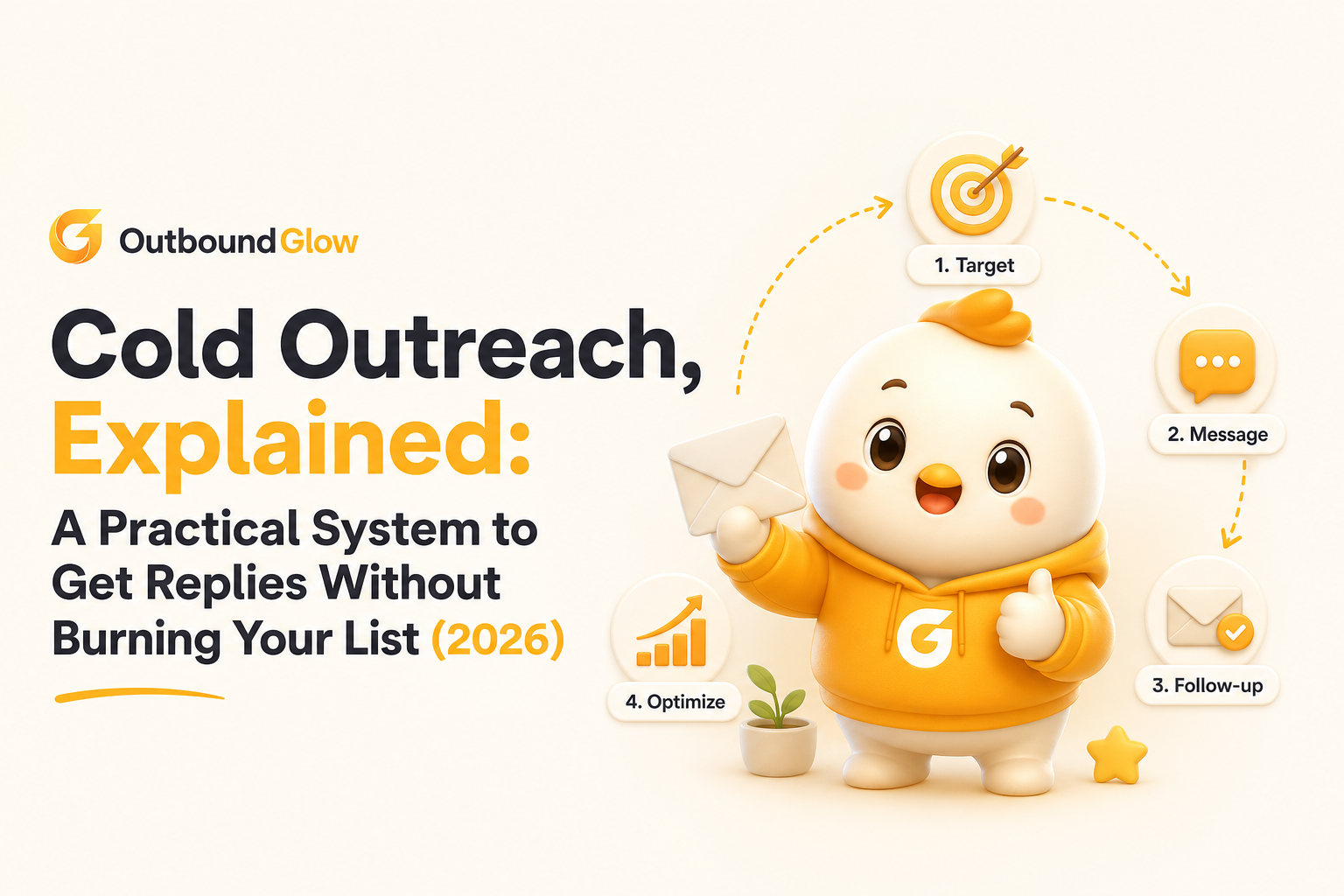
A simple cold outreach system: target, message, follow-up, and optimize.
Phase 3: Follow Up Like a Professional (Not a Spammer)
Most replies come from follow-ups, not the first email. But most teams do follow-ups poorly: they either do not send them at all, or they send annoying “bump” emails with no new value. Cold outreach follow-up should feel like a short, respectful sequence, not a chase.
A 5-touch sequence you can run weekly
Day 0: the core message (context, problem, value, ask).
Day 2: a clarification question (one sentence plus one question).
Day 5: proof point (short result, mini case, or credible observation).
Day 9: alternative angle (different pain, same category).
Day 14: polite close (“Should I close the loop?”) with a referral ask.
Follow-up examples (copy/paste)
Clarification: “If this is not on your radar, who owns onboarding time in your team?”
Proof: “We recently helped a 25-person team reduce back-and-forth on onboarding by standardizing steps and reminders. Worth exploring?”
Polite close: “I have not heard back. Should I close the loop, or is there a better time next month?”
When to stop (simple rules)
Stop the sequence immediately if they reply, even if it is “not now”.
Stop if you get a clear “not interested”.
Stop if your message is no longer relevant (trigger expired, role changed).
Actionable takeaway: Write your follow-ups before you send the first email. If you cannot create 3 to 5 useful touches, your offer is not clear enough yet.
Phase 4: Automate and Optimize Without Losing the Human Feel
Automation is where cold outreach becomes sustainable. Not because it lets you send more, but because it makes your process consistent: list hygiene, timing, follow-up rules, and performance tracking. The goal is to lower mistakes and protect your sender reputation while you learn what works.
What to automate first (in priority order)
List checks: remove invalid addresses before sending.
Sequencing rules: auto-send follow-ups on a schedule, skip weekends if your buyers do.
Auto-stop: stop the sequence when someone replies.
Performance tracking: track replies by segment and by message step, not just overall.
A simple weekly optimization loop (30 minutes)
Pick one segment (do not mix segments in the same test).
Change one variable only (subject line OR opening line OR CTA).
Measure on replies, not opens (opens are noisy because of privacy features).
Keep what improves replies; discard what does not after a reasonable sample.
Where AI helps, and where it hurts
Helps: drafting variations, summarizing public context, generating follow-up angles.
Hurts: generic compliments, long intros, and “AI voice” that sounds like everyone else.
If you want an example of automation done with guardrails (lead selection, personalized sequences, auto-stop on reply, and deliverability monitoring), Outbound Glow is one option to explore. Keep your standard the same either way: automation should increase consistency, not reduce relevance.
Actionable takeaway: Set a hard cap for weekly tests: one segment, one change, one metric. That discipline beats “more tools” every time.
Cold Outreach Checklist (Copy/Paste)
Before you send
Target: I can describe the segment as role + trigger + problem in one sentence.
List: contacts match the segment; no obvious mismatches.
Offer: one measurable outcome, no broad promises.
CTA: one clear next step (reply, referral, short call).
Sequence: 3 to 5 follow-ups written in advance.
While it runs
Stop rules: auto-stop on reply; stop on clear “no”.
Quality signals: watch bounces and negative responses; pause if they spike.
Segment discipline: do not mix multiple ICPs in the same campaign.
After 7 to 14 days
Measure: replies by step and by segment.
Decide: keep, change one variable, or retire the segment.
Document: save the best-performing message as a template.
Actionable takeaway: Print this checklist and run it every time you launch cold outreach. Consistency is your unfair advantage.
FAQ
What is the difference between cold outreach and spam?
Cold outreach is targeted and relevant: you contact a specific person for a specific reason and ask for a simple next step. Spam is high-volume, low-relevance messaging that ignores fit and consent signals. If your message would make sense to almost anyone, it is probably spammy.
How many follow-ups should I send in a cold outreach sequence?
A practical range is 3 to 5 total touches over 10 to 14 days. Fewer touches often leaves replies on the table; too many increases annoyance and negative responses. Each follow-up should add new information, not just “bumping this”.
Should I measure opens or replies for cold outreach?
Prioritize replies and positive outcomes (referrals, meetings) because open tracking can be unreliable due to email privacy features. Opens can still be a directional signal, but do not optimize your whole strategy around them.
How do I personalize cold outreach without spending hours per lead?
Personalize at the segment level first (role, trigger, problem) and only add 1 to 2 lines of individual context when it is easy to verify. A repeatable system usually beats deep research for every contact. If personalization is your bottleneck, build templates per segment and vary the first line.
If you want to see how an AI agent can automate the repetitive parts of cold outreach (finding leads, drafting personalized sequences, scheduling follow-ups, and stopping on reply) while keeping quality guardrails, explore Outbound Glow and start with a small, high-fit campaign you can measure in a week.

Written by Leah Nguyen
Read Next
View all
Instantly Alternative Guide - Pricing, Deliverability, and Best Fit by Use Case
Compare an instantly alternative using a deliverability rubric, true free tiers, and real total cost across solo, team, and agency setups.


Cold Outreach Automation That Actually Scales, The Analytics Framework by Industry
Cold outreach automation that scales needs the right metrics. Use this industry scorecard to track deliverability, qualified replies, and pipeline.
Smartlead Alternative Guide Ranked Options and Real World Pricing Scenarios
Decision-ready smartlead alternative guide with ranked options, normalized pricing scenarios, AI matrix, and a switch checklist for cold email teams.