
Cold Email Personalization: A Practical System to Get Replies Without Burning Time
Cold email personalization sounds simple until you try to do it at scale. You either spend hours researching each prospect, or you cut corners and send “personalized” lines that feel fake. This guide gives you a practical system to personalize quickly, stay relevant, and protect your sender reputation. You will learn what personalization actually means, what to personalize (and what not to), and how to measure whether your personalization is working.
Key takeaways
Personalization is only valuable when it proves relevance to a real business situation, not when it adds a random fact.
Use a repeatable “signal to message” template: signal (proof) + implication (why it matters) + offer bridge (how you help).
Track personalization quality weekly with a small set of metrics: positive reply rate, meeting rate, and “not relevant” replies.
What Cold Email Personalization Is (and Isn’t)
Cold email personalization is the practice of tailoring an outreach email to a specific recipient using verifiable context about their role, company, and current priorities, so the message feels relevant and earns a reply. The goal is not to “sound friendly.” The goal is to reduce the recipient’s mental work to answer one question: “Is this for me, right now?”
Two definitions that prevent wasted effort
Personalization is not flattery. “Loved your website” is not personalization unless you point to a specific business choice and why it matters.
Personalization is not a trivia contest. Mentioning a random podcast episode or hobby can backfire if it does not connect to a business outcome.
A simple test: the “So what?” filter
If your first line includes a detail, ask: So what does that change about their priorities, risks, or growth plans?
If you cannot answer in one sentence, remove it.
Actionable takeaway: Before writing any email, write one sentence: “This matters to them because ____.” If you can’t, you do not have personalization yet.
Why Cold Email Personalization Matters
Cold email personalization matters because inboxes are crowded and recipients have learned to ignore anything that looks mass-sent. Personalization is one of the few levers that can increase replies without increasing volume (which can harm your sender reputation).
What the data says (and what it doesn’t)
Gartner has repeatedly published research on buyers preferring supplier interactions that are relevant and tailored. While this is not “cold email specific,” it supports the underlying mechanism: relevance drives engagement. See Gartner’s B2B buying journey insights.
Many cold email platforms publish benchmarks on open and reply rates, but results vary heavily by list quality, offer, and deliverability practices. Treat benchmarks as directional, not promises.
The business reason: personalization is a conversion multiplier
Think of your outbound results as a chain: deliverability (land in inbox) x opens x replies x meetings. Personalization mostly impacts the last two. Even small improvements compound because every reply you earn comes from the same list and the same sending volume.
Actionable takeaway: If you don’t have time to personalize every email, personalize fewer emails to better-fit prospects instead of blasting more.
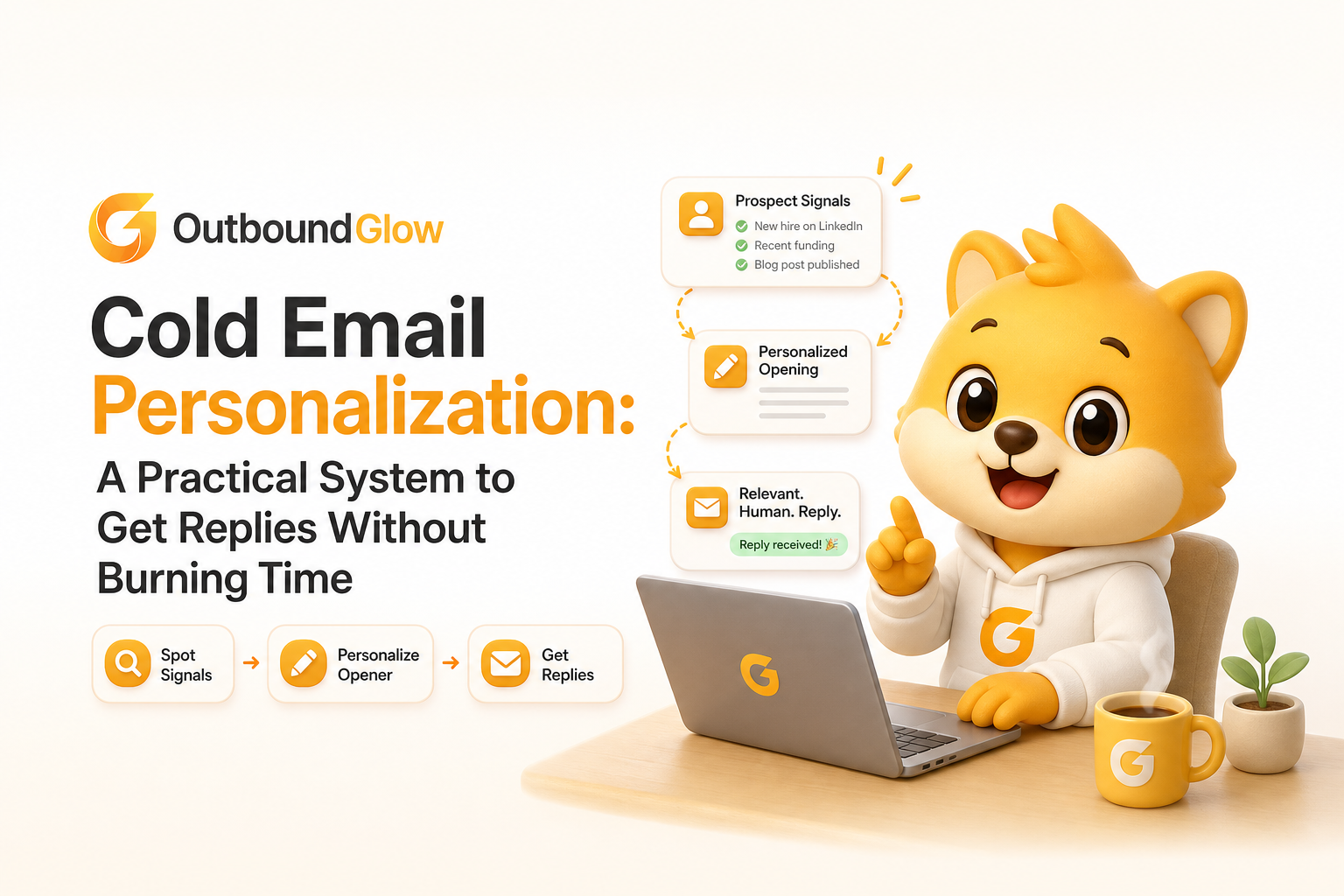
A simple workflow that turns prospect signals into relevant personalized openings.
Phase 1: Choose the Right Personalization Target
Most teams fail at cold email personalization before writing a single word, because they target the wrong people. If the recipient is not a good fit, personalization becomes expensive and still won’t convert.
A 5-minute targeting filter (use before you personalize)
Role fit: Can this person say yes, influence the decision, or feel the pain daily?
Company fit: Industry, size, geography, and business model match your best customers (or your clearest hypothesis).
Timing signal: Something suggests they might care now (hiring, expansion, new product, compliance change, new leadership).
Problem visibility: You can reasonably infer a problem from public info without guessing wildly.
Offer clarity: You can describe your outcome in one sentence without buzzwords.
Decision table: when personalization is worth it
Situation | Personalize deeply? | Why |
|---|---|---|
High ACV, narrow ICP, low volume | Yes | Each reply is valuable; research cost is justified. |
Mid ACV, clear ICP, medium volume | Yes, but template the structure | Repeatable signals and message blocks keep cost down. |
Low ACV, broad ICP, high volume | Limited | Deep research cost often exceeds expected value per lead. |
Unclear ICP or vague offer | No (fix fundamentals first) | Personalization cannot rescue a mismatched message. |
Actionable takeaway: Only personalize for prospects who pass at least 3 of the 5 filters above (role, company, timing, visibility, offer clarity). Otherwise, fix targeting first.
Go deeper: In the series, add a guide titled “ICP Signals for Cold Outreach: A Practical List” and link it here once published.
Phase 2: Gather Proof, Not Trivia
Good cold email personalization is built from proof: facts that indicate a business priority. Bad personalization is built from trivia: facts that do not change what the recipient should do next.
The 4 buckets of personalization signals (ranked by usefulness)
Company change: funding, hiring, new market, new product page, pricing change, partnership announcement.
Role responsibility: what the person likely owns (pipeline, retention, recruiting, finance close) based on title and team.
Customer or product clues: who they sell to, what they claim on their site, what case studies reveal.
Personal content: posts, talks, podcasts. Useful only when tied to a business decision.
A research checklist you can finish in 2 to 4 minutes
Website: homepage promise, pricing page (if public), one case study.
LinkedIn: title, last 2 posts, and company headcount trend (if visible).
One “fresh” signal: hiring page, recent announcement, or product update.
Turn signals into “reason to email” statements
Use this conversion template:
Signal: “I noticed ____.”
Implication: “That usually means ____ becomes a priority.”
Bridge: “If that’s true, ____ might help because ____.”
Actionable takeaway: If you cannot write the implication sentence, you have trivia, not proof. Remove it and find a better signal.
Go deeper: Add a series article titled “Prospect Research for Cold Email Personalization: A 10-Minute Workflow” and link it here once published.
Phase 3: Write Personalization That Connects to Your Offer
This is where most “personalized” cold emails fail: they mention a fact, then jump to a generic pitch. The recipient feels the mismatch immediately.
The “3-sentence opening” framework
Context sentence: one specific, verifiable observation.
Relevance sentence: explain why that observation matters to them now.
Bridge sentence: connect to your offer with one clear outcome.
Concrete example (good vs. bad)
Bad (trivia + generic pitch):
“Saw your recent LinkedIn post, great insights. We help companies grow with an all-in-one platform. Want to chat?”
Better (proof + implication + bridge):
“Noticed you’re hiring 3 SDRs in the last month. That usually means you’re about to increase outbound volume and need message quality to stay consistent. If you’re open to it, I can share a simple personalization structure we’ve used to keep reply quality up while scaling outreach.”
Personalization depth levels (so you don’t overdo it)
Level 1: Role-based relevance (fastest). Good for most campaigns.
Level 2: Company signal-based relevance. Best ROI for mid-volume outreach.
Level 3: Account-specific narrative (multi-stakeholder, high value). Use sparingly.
Common personalization mistakes (with fixes)
Mistake: Overly long first line. Fix: Keep the personalized context under 20 words.
Mistake: Too many facts. Fix: Use one signal, then explain why it matters.
Mistake: “We are” paragraphs. Fix: Replace with “If you are seeing X, then Y.”
Actionable takeaway: Rewrite your first 3 sentences using the framework above, then delete every word that does not support relevance or the outcome.
Go deeper: Add a series article titled “Cold Email Opening Lines: 25 Templates Based on Real Signals” and link it here once published.
Phase 4: QA, Measure, and Improve Weekly
Cold email personalization is not a one-time writing task. It is a weekly improvement loop. If you do not measure, you will keep investing time into signals that do not convert.
A lightweight QA checklist before sending
Verifiable: Can the recipient confirm the signal in 5 seconds?
Relevant: Does the signal connect to a business priority?
Specific: Did you avoid vague claims like “increase growth”?
Respectful: No creepy details, no personal life references.
One ask: One clear next step (reply with a yes/no, or a short call).
Weekly measurement: 3 metrics that actually guide decisions
Positive reply rate: “Yes,” “interested,” “send info,” “not now but later.”
Meeting rate: booked meetings per emails sent (more meaningful than opens).
“Not relevant” replies: a targeting or relevance warning signal.
A/B testing personalization without overcomplicating it
Test one signal type at a time (hiring vs. product update vs. role responsibility).
Keep the offer and ask identical.
Run until each variant has at least 100 sends if possible, otherwise treat results as directional.
When tools help (and what to demand from them)
If you use AI to speed up cold email personalization, demand two things: (1) it should pull from real, current sources, and (2) it should keep your structure consistent so you can measure what works. For example, Outbound Glow is one way teams automate prospect research and draft personalized openings while keeping a human review step before sending.
Actionable takeaway: Every Friday, pick one winning signal type and one losing signal type, then adjust next week’s list building and opening lines accordingly.
Cold Email Personalization Checklist (Copy/Paste)
Use this checklist to run cold email personalization as a repeatable process instead of a creative writing exercise.
Targeting
[ ] Prospect matches role fit
[ ] Prospect matches company fit
[ ] You have at least one timing signal
[ ] You can infer a likely priority without guessing
[ ] Your offer outcome fits in one sentence
Research (2 to 4 minutes)
[ ] One website clue (promise, product, or case study)
[ ] One LinkedIn clue (title + recent post or company update)
[ ] One fresh signal (hiring, announcement, product update)
Writing (3-sentence opening)
[ ] Context sentence: one verifiable observation
[ ] Relevance sentence: why it matters now
[ ] Bridge sentence: one outcome you help with
QA before sending
[ ] No trivia that does not change the business case
[ ] No “creepy” personal details
[ ] One clear next step
[ ] Entire email under 120 to 160 words (as a starting point)
Weekly improvement
[ ] Review positive replies and tag the signal type used
[ ] Review “not relevant” replies and adjust targeting
[ ] Keep a shortlist of 3 best-performing opening patterns
Actionable takeaway: Print this checklist and use it for the next 20 emails. Then compare results to your last 20 emails without a checklist.
FAQ
How many personalized lines should a cold email have?
Usually one strong personalized signal is enough. Add a second only if it strengthens the business relevance, not just the “human” feel. If two signals point to the same priority, keep the clearer one.
What is the difference between personalization and segmentation?
Segmentation tailors messaging to a group (for example, “SaaS founders in Series A”). Personalization tailors messaging to one person using specific context (for example, “hiring SDRs this month”). Good outbound uses both: segment first, personalize second.
Does cold email personalization improve deliverability?
Personalization primarily improves replies, not inbox placement. That said, sending unique emails can reduce the risk of repeating the same text across many sends, which is a common pattern in low-quality outreach. Deliverability still depends on list quality and responsible sending habits.
What should I personalize if I have very little public info?
Personalize to role responsibility and the company’s public positioning (homepage promise, product pages, and customer stories). If you cannot find a credible signal in 2 to 3 minutes, the prospect may not be worth deep personalization.
How do I avoid “creepy” personalization?
Stick to professional, public information that the recipient expects a stranger to see: company news, website updates, hiring, and work-related posts. Avoid personal life details and anything that suggests you tracked them across multiple platforms.
If you want to apply this framework without spending hours on research, you can see how Outbound Glow automates prospect research and drafts personalized openings you can review before sending. Try it on a small batch of 20 prospects and compare your positive reply rate week over week.
Adrian Nguyen
Adrian Nguyen is an expert on automation, SEO and AI fields. Let's help his spread the words.
Stay in the loop
Actionable outbound growth tactics, AI workflows, and founder-tested outreach strategies delivered weekly.