
Prospect Research That Scales, A Signal-Based Framework for B2B Teams
Learn prospect research that scales using buying signals, scoring, and messaging inputs to prioritize accounts and personalize outreach without rabbit holes.
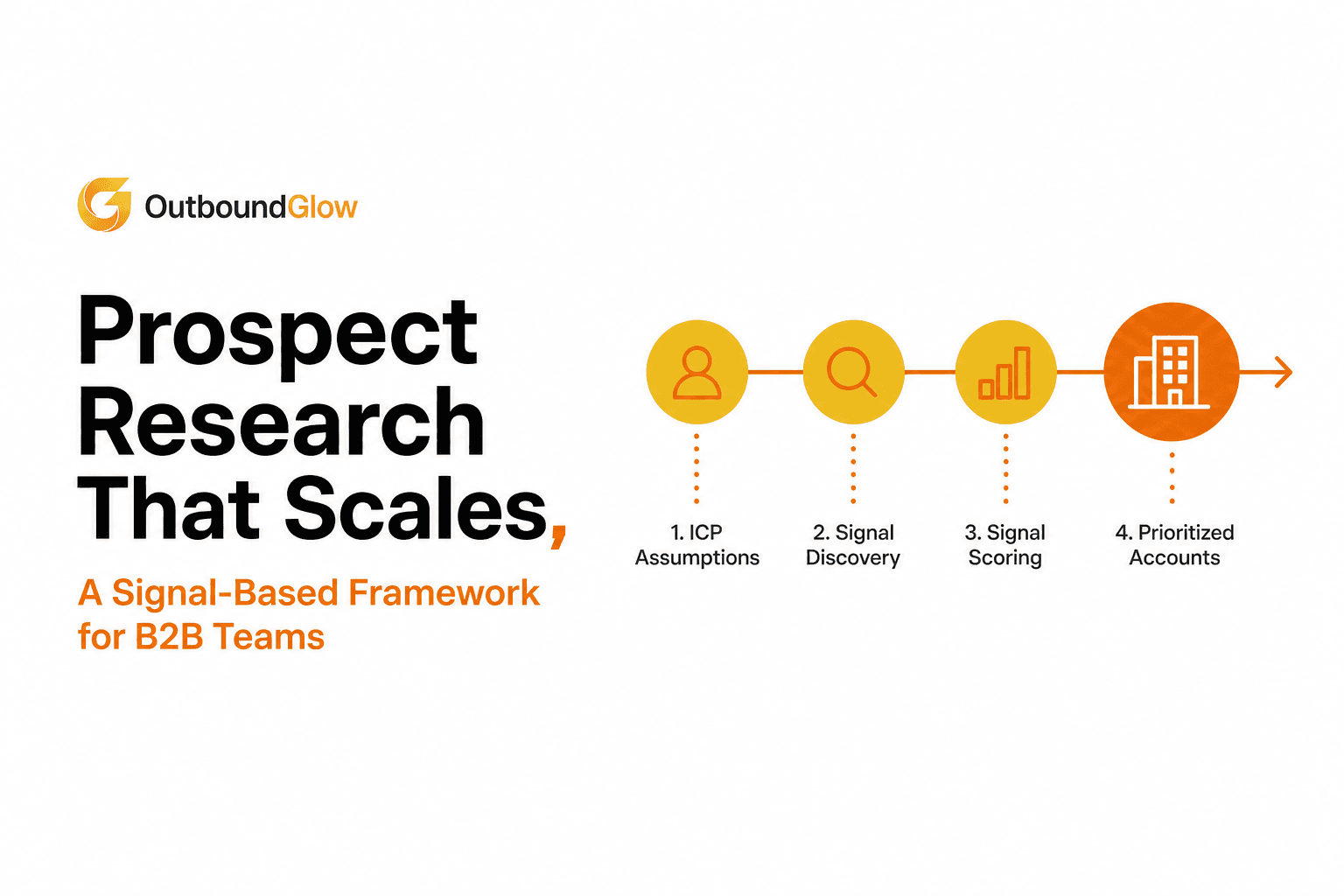
Prospect research breaks down when your team spends 30 minutes per account collecting “interesting facts” but still cannot explain why that company should buy now. The result is a list that looks targeted on paper, yet produces low replies because timing, need, and authority were never validated. This guide gives you a repeatable, signal-based prospect research framework: you will define industry buying triggers, score accounts with a simple 3-layer model, and translate signals into outreach inputs that stay personal at scale.
Key takeaways
Start with buying signals (need, timing, authority) and only then collect supporting company facts.
Prioritize accounts with a 3-layer score using firmographics, technographics, and intent signals so reps work the highest-likelihood list first.
Convert research into messaging variables (angles, proof, objections) to keep personalization consistent across campaigns.
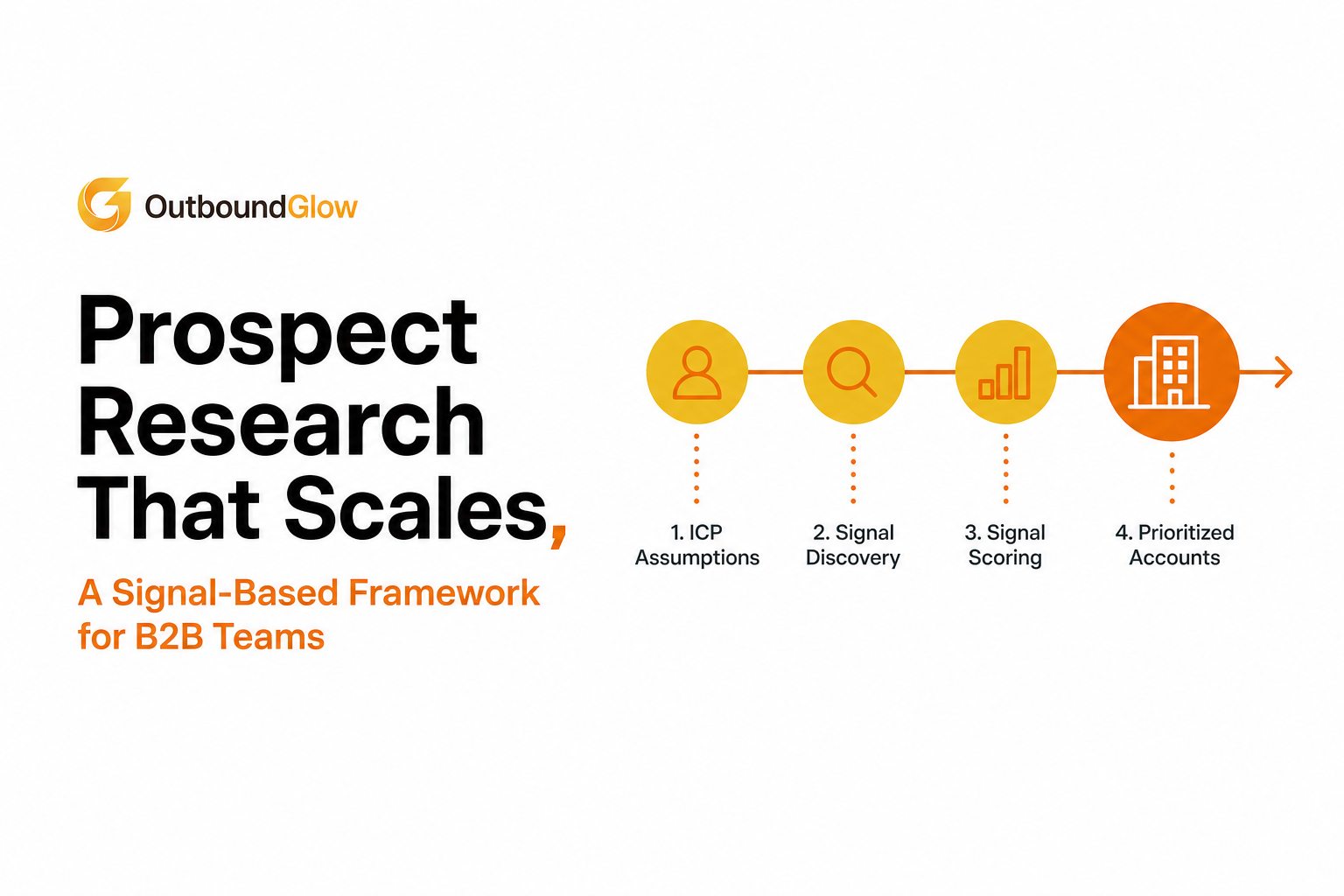
A signal-based prospect research workflow from ICP assumptions to prioritized accounts.
What is prospect research?
Prospect research is the process of collecting and interpreting account and contact signals to identify who is most likely to buy, why they would buy, and what message will resonate, so you can prioritize outreach and personalize it without guessing.
Prospect research vs. “company research”
Company research gathers facts (headcount, locations, leadership bios) that may not predict purchase.
Prospect research focuses on signals tied to need, timing, and decision power, then turns those signals into outreach inputs.
The outcome you should expect
At the end of prospect research, you should have: (1) a prioritized account list, (2) named contacts mapped to a buying committee, and (3) a short set of message angles with evidence for each segment.
Why prospect research matters for deliverability and pipeline
Bad targeting creates deliverability problems, not just low replies
If you email the wrong people, you do not only get silence. You trigger negative engagement (deletes, spam complaints) that harms inbox placement over time. Instantly highlights that spam complaints and low engagement are key factors that reduce deliverability, which means poor targeting can degrade results even when your copy is solid.
“List noise” is a measurable cost
When lists contain stale or irrelevant contacts, teams see higher bounce rates, more unsubscribes, and wasted rep hours. Gartner has long emphasized that B2B buying involves multiple stakeholders and non-linear journeys; if your research does not identify the right roles and triggers, you end up emailing people who cannot act.
Actionable takeaway
Set a minimum standard for prospect research output: every account must have at least one “why now” signal and one “who owns this” contact before it enters a sequence.
Start with buying signals, not company facts
The fastest way to scale prospect research is to stop collecting everything and instead define a small set of triggers that indicate need, timing, and authority. Think of these as testable signals you can verify quickly across many accounts.
Step 1: Write your “signal hypothesis” per industry
Use this template for each industry you sell into:
Need signal: What operational pain or growth goal forces this buyer to act?
Timing signal: What event makes action urgent in the next 30 to 90 days?
Authority signal: Which role can approve budget or start a pilot?
Step 2: Pick 5 to 7 signals you can actually find repeatedly
A scalable signal set is small, observable, and consistent. Here are examples you can adapt.
SaaS: hiring for RevOps, new pricing page, launch on Product Hunt, funding announcement, churn-reduction initiatives.
Manufacturing: ERP migration, ISO compliance updates, plant expansion, supply chain disruption mentions, new distributor onboarding.
Professional services: new office location, partner promotions, inbound content push, new retainer offering, tech stack modernization.
Ecommerce: new fulfillment partner, international expansion, site replatforming, paid media hiring, seasonal inventory ramp.
Step 3: Define “disqualifying signals” to avoid rabbit holes
Disqualifiers prevent wasted research. Examples:
Role mismatch (only junior titles available in target function).
Customer type mismatch (you sell to B2B, they are DTC-only).
Tech constraint (they already use an exclusive vendor you cannot integrate with).
Actionable takeaway
Create a one-page “signal dictionary” per industry: each signal includes where to find it, what it implies, and the outreach angle it supports. If you need a practical walkthrough on the mechanics, see research prospects.
A 3-layer prospect research system for prioritizing accounts
Once you have signals, you need a scoring model that tells your team what to work first. A simple 3-layer system keeps prospect research consistent across reps and prevents “whoever shouts loudest” prioritization.
Layer 1: Firmographics (Fit)
Firmographics answer: “Should we ever sell to them?” Use 3 to 5 criteria max.
Industry and sub-industry
Company size (employees or revenue band)
Geography (selling constraints, language, time zones)
Business model (B2B vs B2C, enterprise vs SMB)
Layer 2: Technographics (Feasibility)
Technographics answer: “Can they adopt quickly?” Choose signals tied to implementation and switching costs.
Core system in your category (CRM, ESP, data warehouse, payment stack)
Evidence of modern tooling (recent stack changes, job posts for tooling)
Compatibility constraints (security requirements, hosting, compliance)
Layer 3: Intent and triggers (Likelihood to buy now)
This is where timing lives. Examples of intent sources:
Job posts that mention the problem you solve
Leadership changes in the owning function
Announcements: funding, expansion, acquisitions
Website changes that imply a new motion (new pricing, new product page)
A simple scoring model you can implement this week
Use a 0 to 100 score with clear weights so anyone can apply it:
Fit (Firmographics): 0 to 40
Feasibility (Technographics): 0 to 20
Timing (Intent): 0 to 40
Then define action bands:
80 to 100: outbound now, multi-touch sequence, highest personalization
60 to 79: outbound now, lighter personalization, monitor intent
40 to 59: nurture list, re-check triggers monthly
0 to 39: exclude
Actionable takeaway
Score accounts before you pick contacts. It sounds backward, but it prevents you from spending time finding emails for accounts you should not target. For a full outreach operating system after scoring, read cold outreach.
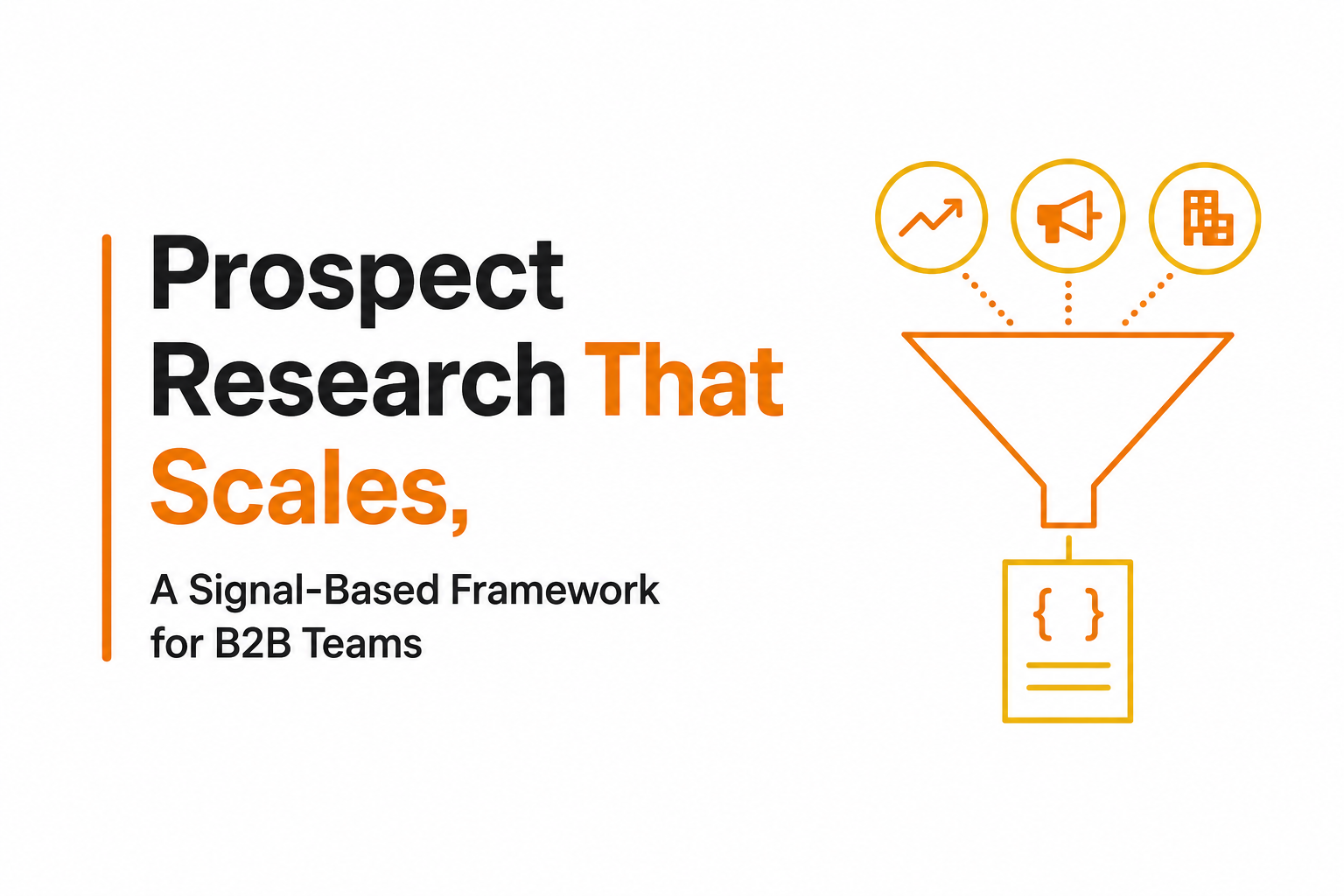
Example of turning buying signals into reusable messaging variables for outreach.
Turn research into outreach inputs without losing personalization
Prospect research only pays off when it becomes usable inputs for messaging. The mistake is to treat personalization as writing unique emails from scratch. Instead, turn signals into structured variables your campaigns can reuse.
Convert signals into 4 messaging variables
Angle: the “why this, why now” narrative (for example: hiring RevOps implies process scaling pain).
Proof: a credible outcome or mini case relevant to the angle (time saved, faster ramp, fewer errors).
Objection: what a smart buyer will push back on (timing, switching cost, data quality, security).
CTA type: the lowest-friction next step (5-minute fit check, quick audit, benchmark share).
Build a “signal to snippet” library
Create a small library where each signal maps to:
1 opening line pattern
1 value hypothesis
1 question that qualifies timing
Example mapping for SaaS:
Signal: hiring SDR Manager
Opening: “Saw you are hiring an SDR Manager, usually that means you are standardizing outbound and ramp.”
Hypothesis: “Teams at that stage often struggle with list quality and deliverability.”
Question: “Are you building net-new outbound this quarter or optimizing an existing motion?”
Personalization rule that scales
Use 1 to 2 verified signals per email, not 5. More facts often reduce clarity and increase the chance you mention something irrelevant. If you want a practical system for writing with variables, see cold email personalization.
Actionable takeaway
Before launching a campaign, audit 20 accounts and confirm your top 2 signals correlate with real conversations. If they do not, change the signals, not the copy.
Prospect research checklist you can reuse
Signal setup (per industry)
Define 1 need signal, 1 timing signal, 1 authority signal.
Choose 5 to 7 observable triggers and 3 disqualifiers.
Document where each signal is found and how often it updates.
Account scoring (per account)
Score Fit (0 to 40) using 3 to 5 firmographic rules.
Score Feasibility (0 to 20) using 1 to 3 technographic checks.
Score Timing (0 to 40) using 1 to 3 recent triggers.
Assign an action band (work now, work later, exclude).
Contact mapping (per account)
Identify the owning function and 2 adjacent stakeholders.
Pick 1 primary contact and 1 alternate if the first bounces or is out-of-office.
Messaging inputs (per segment)
For each top signal, write: angle, proof, objection, CTA type.
Create a snippet library with 1 opening pattern and 1 qualifying question per signal.
Actionable takeaway
If you cannot fill the checklist in under 6 minutes per account for your “60 to 79” band, your signals are too complex for scaled prospect research.
FAQ
How many signals should I use for prospect research?
Start with 5 to 7 positive signals and 3 disqualifiers per industry. If a rep cannot apply the signals consistently in under 8 minutes per account, reduce the list.
What is a good prospect research score threshold to start outreach?
Use a threshold like 60/100 to start, then adjust based on reply and meeting rates. Keep a separate “80+” band for your highest personalization and best accounts.
How do I avoid spending too long on personalization?
Limit each email to 1 to 2 verified signals and use a snippet library tied to those signals. Personalization should change the angle and question, not rewrite the entire email.
Should I prioritize accounts or contacts first?
Prioritize accounts first using fit, feasibility, and timing. Then map contacts inside the best accounts so you do not waste time finding emails for low-priority targets.
If you want to automate the research-to-list-to-personalization loop, see how Outbound Glow helps teams generate ICP-matched, verified leads and turn prospect research signals into personalized sequences while protecting deliverability.

Written by Leah Nguyen
Read Next
View all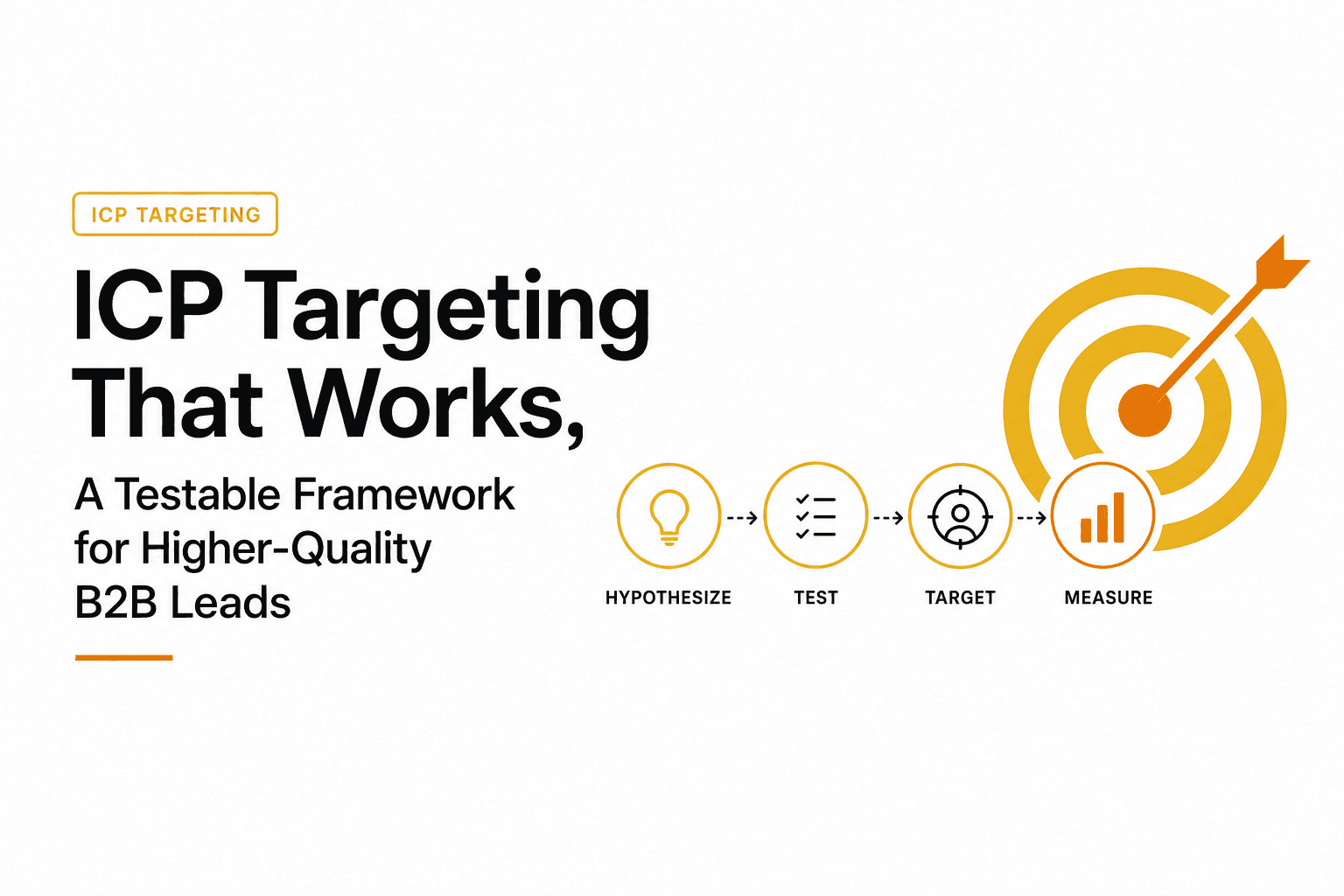
ICP Targeting That Works, A Testable Framework for Higher-Quality B2B Leads
Learn icp targeting with a testable framework: hypotheses, industry rules, signals, scorecards, and outbound workflow to improve replies and pipeline quality.

Lead Database Meaning and How to Choose the Right One for B2B Sales
Learn what a lead database means, how to evaluate B2B data quality fast, and how to shortlist providers with a practical scorecard.

How to research prospects for cold email
Learn a fast, practical framework to research prospects, capture fit and intent signals, and turn findings into reusable outreach briefs.