
ICP Targeting That Works, A Testable Framework for Higher-Quality B2B Leads
Learn icp targeting with a testable framework: hypotheses, industry rules, signals, scorecards, and outbound workflow to improve replies and pipeline quality.
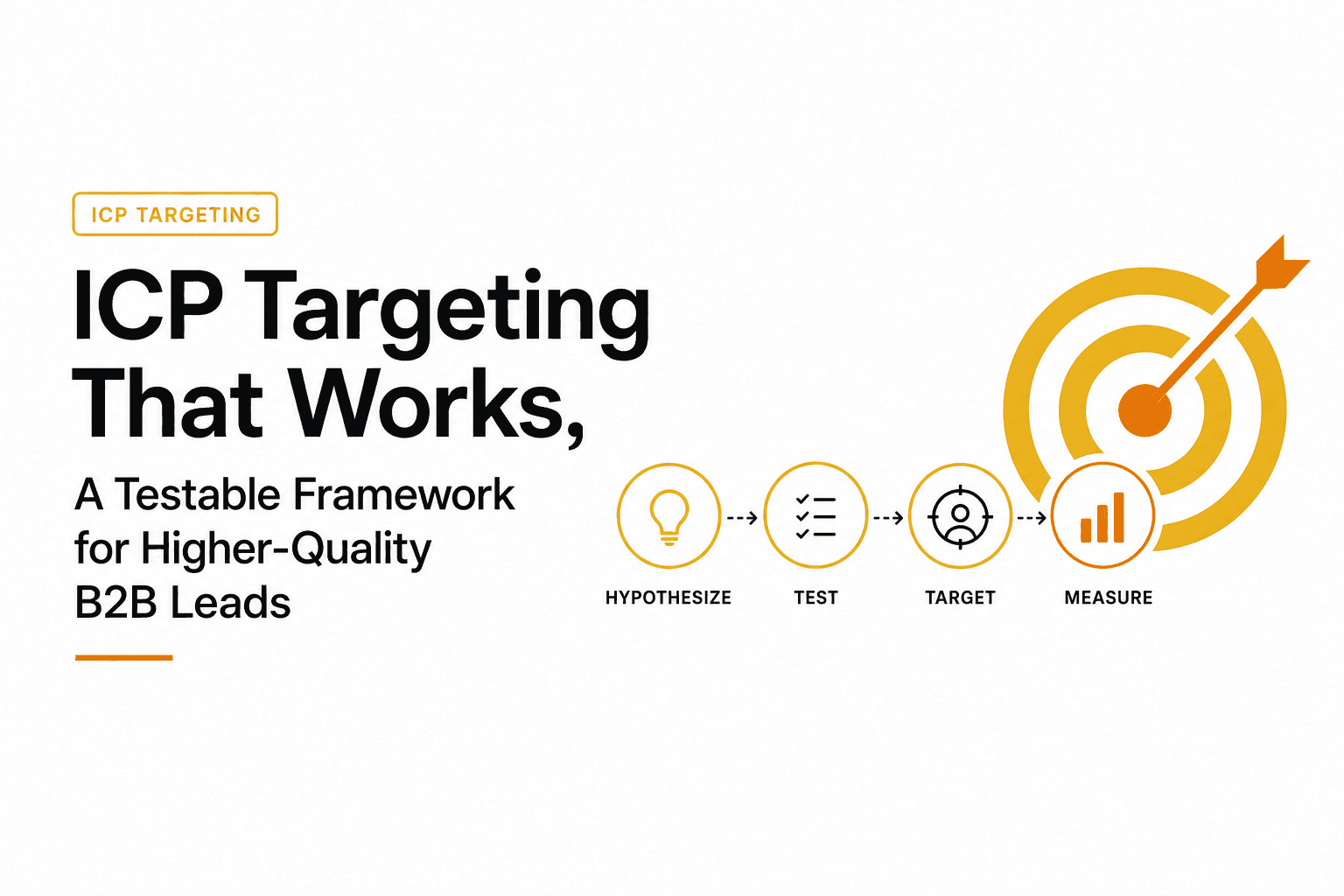
If your team says you have an ICP but your reply rates look random, the problem is usually not “copy” or “volume”, it is icp targeting that is too vague to test. This guide turns a fuzzy profile into a measurable targeting system you can validate by industry, refine with signals, and scale without filling your list with “maybe” accounts.
- Turn icp targeting into a hypothesis with explicit triggers, disqualifiers, and expected outcomes, then test it on small samples before scaling.
- Build targeting rules by industry using firmographic, technographic, and intent filters, plus contact-level mapping so the right accounts reach the right people.
- Use a simple scorecard (deliverability, replies, meetings, pipeline quality) to decide when to tighten vs expand your criteria.
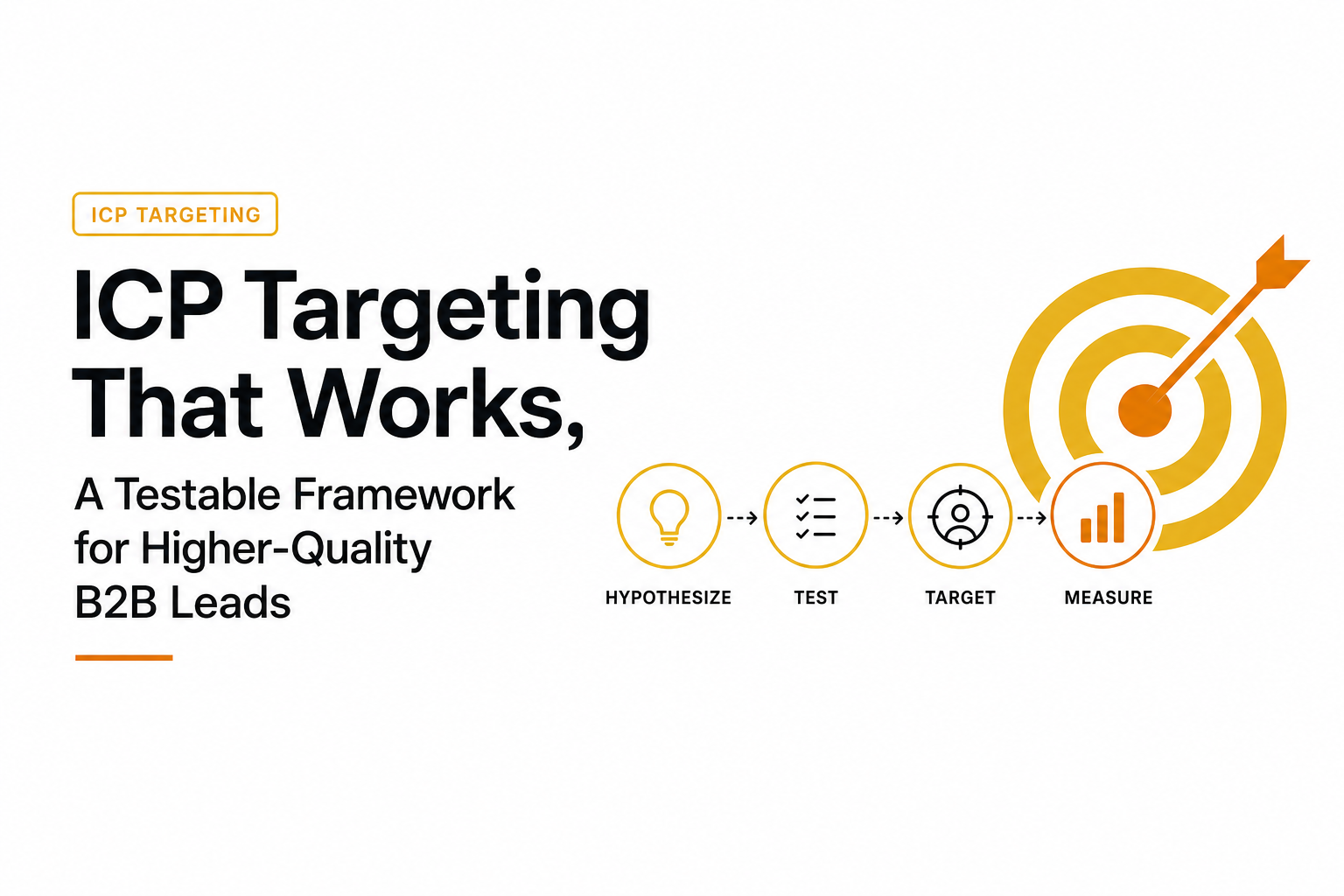
Build an ICP Targeting Hypothesis You Can Actually Test
The most common failure mode in icp targeting is writing an “ICP description” that reads like a brand persona: “mid-market SaaS, modern stack, values efficiency.” That is not testable. A testable hypothesis ties segment assumptions to buying triggers, disqualifiers, and a measurable outcome like reply rate, meeting rate, or sales cycle length.
A 1-page hypothesis template
- Segment: Industry + geography + company size + business model
- Problem we solve: A single painful, urgent problem (not a feature)
- Buying trigger (observable): Events that increase urgency
- Disqualifiers: Conditions that make success unlikely
- Who feels the pain: Primary persona + secondary influencer
- Expected outcomes: What improves and how you will measure it
Translate “good fit” into observable triggers
Good triggers are things you can actually filter or detect, not opinions. Examples:
- Hiring: “Hiring 2+ SDRs” or “hiring RevOps” suggests an outbound or ops problem.
- Tooling change: New CRM, new email platform, new data warehouse.
- Growth event: Funding round, expansion into a new region, new product line.
- Compliance deadline: Security, privacy, or industry regulation changes.
Write disqualifiers that protect your time and your domain
Disqualifiers are not “nice to have.” They prevent you from sending to accounts that will never convert and from pushing volume that harms deliverability. Examples:
- Low willingness to pay: Self-serve SMB that caps spend at $99/mo.
- Wrong operating model: No sales team for a sales-led offer.
- Incompatible environment: Gov or healthcare when you cannot meet procurement or compliance requirements.
Set a minimum viable test size and success criteria
For a first pass, test in small, controlled batches so you can learn fast:
- Sample size: 100 to 300 prospects per segment is often enough to see directional differences in replies, assuming your deliverability is stable.
- Primary success metric: Positive reply rate (not total replies). Track “interested” and “not now but relevant” separately.
- Guardrails: Bounce rate under 2% and spam complaints near zero. If you cannot keep those stable, your test results are noise.
Turn the Hypothesis Into ICP Targeting Rules by Industry
Once your hypothesis is written, you need targeting rules that can be executed in a lead source, CRM, or outbound platform. Think in three layers: firmographic (who they are), technographic (how they operate), and intent (why now). This is where icp targeting becomes operational.
A practical filter stack you can reuse
- Firmographic: industry, employee count, revenue band, region, ownership type
- Technographic: CRM, marketing automation, data warehouse, cloud provider, security tooling
- Intent and signals: hiring, funding, job changes, keyword mentions, recent integrations, product launches
Industry examples with pitfalls
Use these as starting points, then adjust based on your win-loss data.
-
B2B SaaS (sales-led or hybrid)
- Firmographic: 11 to 200 employees; US/EU; clear sales function
- Technographic: CRM present (Salesforce/HubSpot), sales engagement tool or at least tracked outbound
- Intent: hiring SDR/AE, funding within 12 months, new GTM leader
- Pitfall: targeting “SaaS” too broadly. Narrow by motion (PLG vs sales-led), ACV band, or buyer persona.
-
Professional services (agencies, consultancies)
- Firmographic: 10 to 100 employees; project-based revenue; visible case studies
- Technographic: scheduling + CRM usage; evidence of outbound or partnerships
- Intent: hiring business development, launching a new service line, expanding to a new vertical
- Pitfall: lists overloaded with freelancers and micro-shops that will never buy or have no process.
-
Manufacturing and industrial (mid-market)
- Firmographic: 50 to 500 employees; specific sub-vertical (components, packaging, etc.)
- Technographic: ERP presence can be a proxy for maturity; look for modern web stack as a basic marketing signal
- Intent: plant expansion, new compliance requirements, hiring ops leadership
- Pitfall: missing the buying center. “CEO only” outreach often fails; ops and finance influence heavily.
-
Healthcare services (non-enterprise)
- Firmographic: multi-location clinics; region-specific licensing footprint
- Technographic: patient management systems, secure comms tooling
- Intent: new locations, hiring compliance/security, reputation or patient acquisition push
- Pitfall: procurement and compliance cycles. Disqualify early if you cannot support required standards.
Turn rules into a “must-have vs nice-to-have” checklist
This prevents your team from adding filters until the list is tiny or removing filters until the list is garbage.
- Must-have (3 to 5): the smallest set that predicts success
- Nice-to-have (up to 5): improves conversion but should not block tests
- Disqualifiers (3 to 7): conditions that reliably waste time or damage deliverability
Add Contact-Level Targeting So the Right Accounts Reach the Right People
Account-level icp targeting gets you into the right buildings. Contact-level targeting gets you to the right doors. Most outbound underperforms because it mixes these up: great accounts, wrong personas; or correct persona, wrong segment.
Create a persona map tied to pains and proof
For each segment, map 2 to 4 personas. Keep it simple and specific.
- Primary buyer: owns budget and the outcome
- Champion: feels the pain daily and will push internally
- Blocker: security, finance, legal, IT, or operations
A contact targeting matrix you can operationalize
Use this matrix to define who to target, what to reference, and what “proof” to lead with.
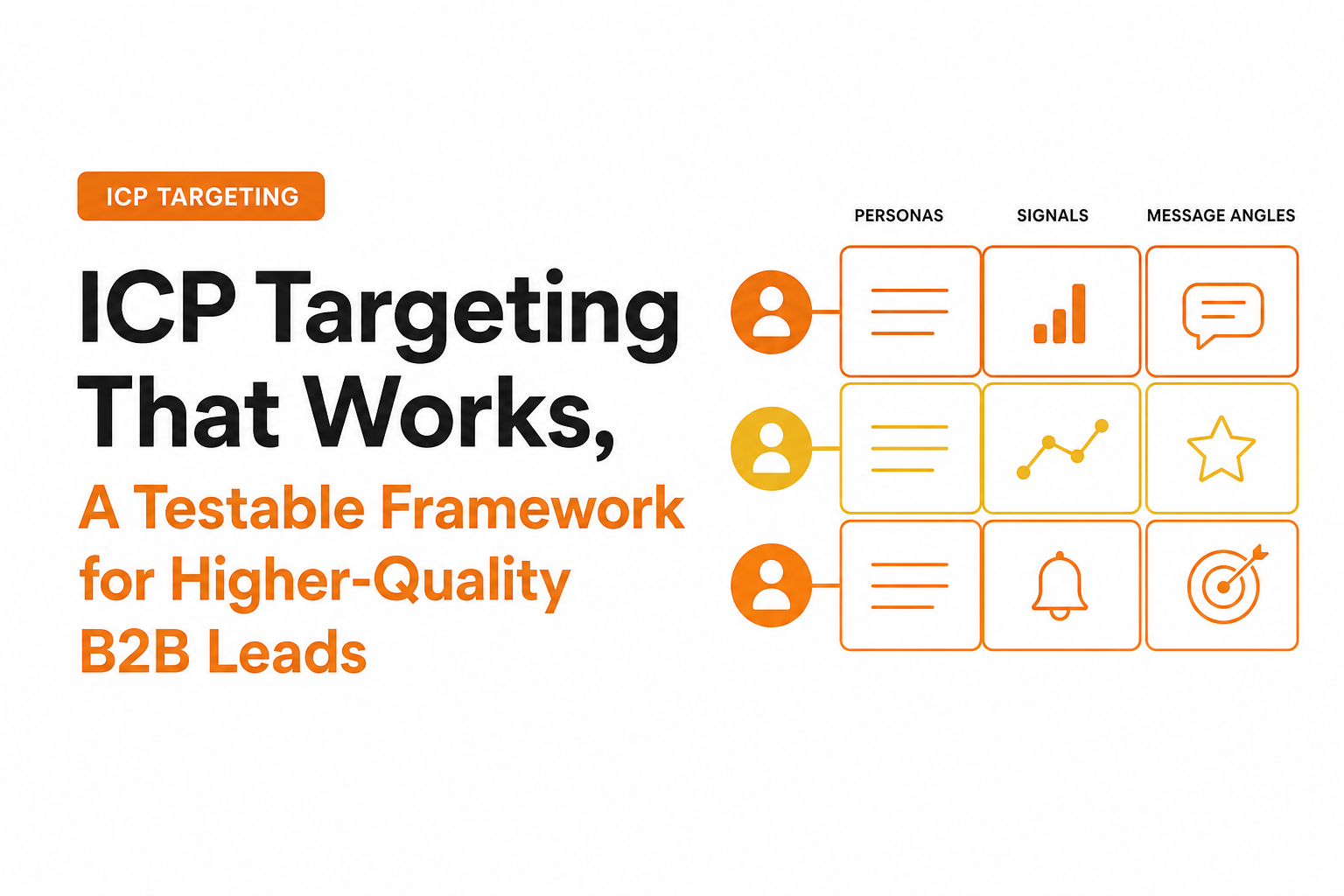
- Function: Sales, Marketing, RevOps, IT/Security, Operations
- Seniority: Manager, Director, VP, C-level
- Pain signals: hiring, tool mentions, job responsibilities, recent posts, role changes
- Message angle: cost reduction, speed, risk reduction, revenue lift
- Path: direct to buyer vs start with champion then loop in buyer
Concrete example: same account, different contact rules
Imagine a 60-person B2B SaaS that matches your segment rules. Here is how contact rules change the approach:
- VP Sales: target if hiring SDRs or complaining about pipeline quality; message angle: meetings and conversion; proof: benchmarks and process.
- RevOps: target if implementing CRM changes; message angle: system reliability and data quality; proof: reduction in bounces, clean attribution.
- Founder/CEO: target if small team and founder-led sales; message angle: time saved and faster learning loops; proof: “from list to sequence in days, not weeks.”
For scalable prospect research, define which signals are required per persona so your team is not guessing what “personalized” means. If you need a step-by-step method, see how to research prospects efficiently without turning every lead into a 20-minute task.
Validate ICP Targeting With Signals Before You Scale Volume
The fastest way to break icp targeting is to scale volume before validation. You end up with list bloat, weak relevance, and deliverability issues that make every metric look worse. Validation means running lightweight experiments that confirm: (1) the segment exists in the data, (2) the trigger is real, and (3) the persona cares.
Use a 3-step validation loop
- Data validity check: Pull 50 to 100 leads and manually spot-check 10 to 20. Are titles accurate? Are companies actually in the industry? Are you seeing the trigger?
- Signal strength check: For each lead, record whether your trigger is clearly present, unclear, or absent. If most are “unclear,” your filter is not operational.
- Message-market check: Run a small sequence with one variable at a time. Keep copy stable and only change segment rules, or keep segment rules stable and only change persona.
Sampling benchmarks to keep you honest
- List noise rate: If more than 20% of your sample is obviously wrong (wrong industry, wrong size, wrong titles), fix targeting before sending.
- Bounce rate: Aim under 2%. Over 3% is a red flag for data quality and can hurt your sender reputation.
- Positive reply rate: Use your own baseline. If a new segment does not beat baseline after a few hundred sends, tighten rules or change triggers.
Validate that your “lead source” is fit for targeting depth
Not every lead database supports the same depth of firmographic, technographic, and intent filtering. If you cannot filter by what you claimed in your hypothesis, your icp targeting will drift and you will blame messaging for a data problem.
Measure and Iterate ICP Targeting Using a Simple Scorecard
Once you have a validated baseline, iteration is about deciding whether to tighten or expand. The mistake is looking only at replies. Good icp targeting improves pipeline quality, not just activity.
A scorecard that separates leading vs lagging indicators
- Leading indicators (weekly): bounce rate, open rate trends (directional), positive reply rate, meeting booked rate
- Lagging indicators (monthly/quarterly): SQL rate, win rate, sales cycle length, average contract value, churn (if applicable)
Cohort your results by segment and persona
Do not average everything together. At minimum, break results into cohorts:
- Segment cohort: industry + size band
- Trigger cohort: funding vs hiring vs tooling change
- Persona cohort: VP vs Director vs Manager
Rules of thumb for tighten vs expand
- Tighten when: bounce rises, spam complaints rise, or positive replies drop while volume increases. This usually means list quality or relevance is slipping.
- Expand when: positive replies and meetings stay stable across multiple cohorts and your team is capacity-limited by list size, not by sales follow-up.
- Change triggers when: segment is right but timing is wrong. If replies are “we already solved this” or “not a priority,” your trigger is weak.
Operationalize ICP Targeting in Outbound Without Burning Your Domain
Scaling icp targeting safely is a workflow problem: sourcing, verification, personalization, sending limits, and stop rules. If any part is missing, you either waste time on manual work or you push bad volume that damages deliverability.
A repeatable workflow you can run weekly
- Define targeting rules: must-haves, nice-to-haves, disqualifiers, and persona map.
- Source a fresh batch: build a list for one segment and one trigger.
- Verify and clean: remove risky emails and duplicates before they touch your sending domain.
- Personalize with constraints: require 1 to 2 signals per lead and keep the rest templated.
- Send with guardrails: daily limits, bounce thresholds, auto-pause rules.
- Review scorecard: cohort results, then tighten or expand one variable.
Deliverability safeguards that protect learning speed
- Keep bounces low: verification and suppression lists are non-negotiable.
- Use conservative ramp-up: increase daily sends gradually as reply quality holds steady.
- Stop rules: pause sequences if bounce or complaint rates spike, then diagnose list quality before resuming.
Where tools fit
Your outreach system should make it easy to run tight experiments without manual overhead. For example, when you move from hypothesis to execution, you will repeatedly do list building, verification, and then cold email personalization. When those steps are slow, teams compensate by loosening targeting and blasting, which is the opposite of good icp targeting. For a full system view of sequencing and reply handling, see this guide to cold outreach that does not burn your list.
| Stage | What you do | Output | Common failure | Fix |
|---|---|---|---|---|
| Hypothesis | Define segment, trigger, disqualifiers, persona | Testable ICP statement | Too broad to execute | Write must-haves and disqualifiers |
| Rules | Firmographic + technographic + intent filters | Queryable targeting rules | Filters not available in data | Swap triggers or simplify filters |
| Contacts | Persona mapping and seniority constraints | Contact selection criteria | Right accounts, wrong people | Build a persona matrix per segment |
| Validation | Small-batch experiments and spot checks | Baseline metrics by cohort | Scaling before learning | Run 100 to 300 per cohort first |
| Iteration | Scorecard review and one-variable changes | Improving pipeline quality | Chasing vanity metrics | Track meetings and SQL rate by cohort |
FAQ
How many filters are too many for icp targeting?
If adding a filter makes most of your sample “unclear” (you cannot verify it on a quick spot-check), it is too many or it is the wrong kind. Start with 3 to 5 must-haves, then add nice-to-haves only after you have a stable baseline.
What is a good bounce rate for outbound?
Under 2% is a practical target for cold email. Over 3% is a warning sign that your data is stale or your verification is insufficient. High bounces can hurt deliverability and make experiments unreliable. For email standards and authentication basics, reference DMARC.
Should I target multiple industries at once?
You can, but only if you keep cohorts separate. Run one sequence per industry and persona so you can attribute results. If everything is mixed into one campaign, you will not know what to tighten or expand.
How do I know if the problem is targeting or messaging?
Diagnose in order: deliverability (bounces and complaints), then targeting relevance (spot-check signals and persona fit), then messaging. If you are reaching the wrong persona or missing the trigger, even great copy will underperform.
If you want to operationalize icp targeting end-to-end, Outbound Glow helps teams go from ICP rules to clean, verified lead lists and personalized sequences with guardrails that protect deliverability, so you can test segments quickly without wasting sends on “maybe” prospects.

Written by Leah Nguyen
Read Next
View all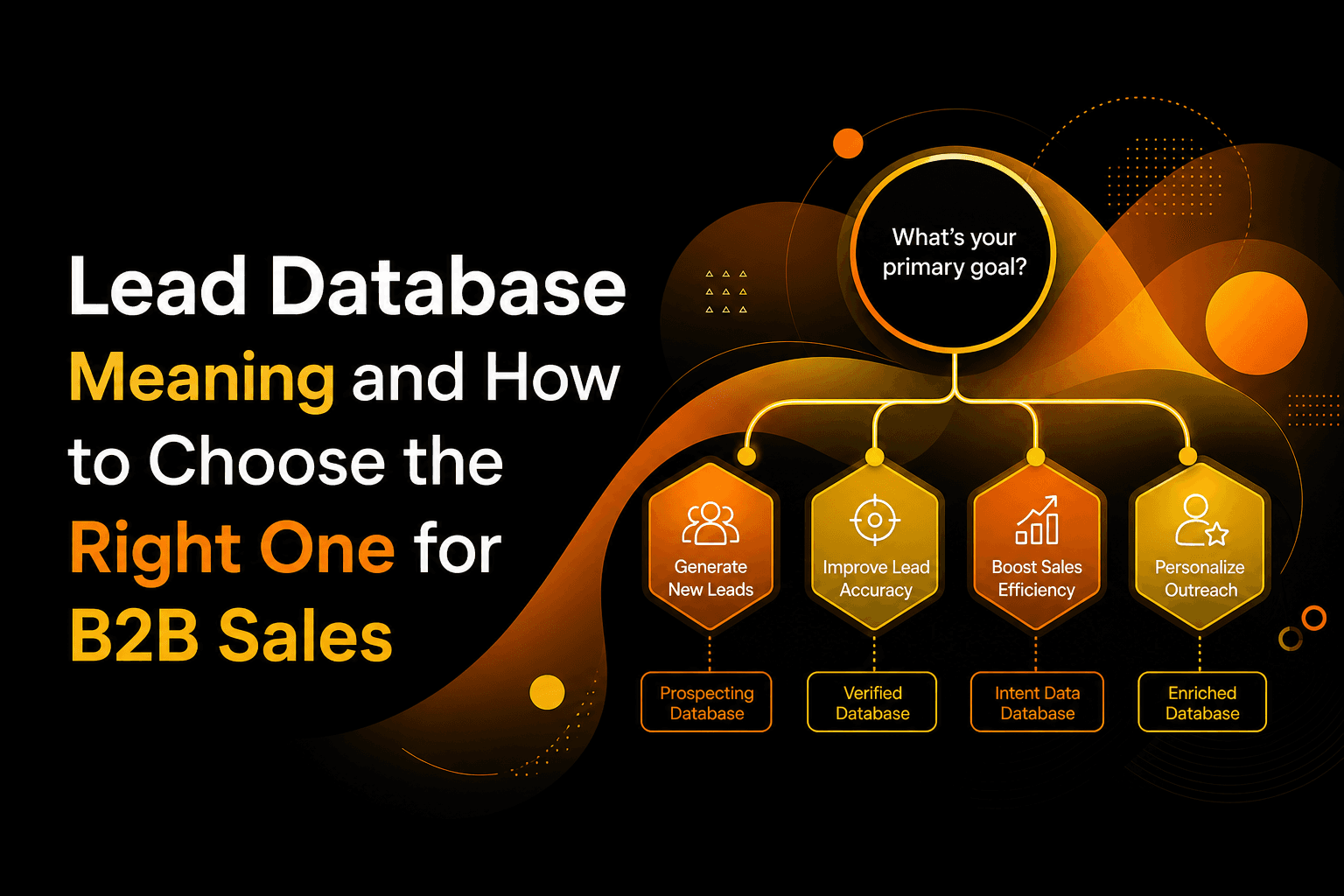
Lead Database Meaning and How to Choose the Right One for B2B Sales
Learn what a lead database means, how to evaluate B2B data quality fast, and how to shortlist providers with a practical scorecard.

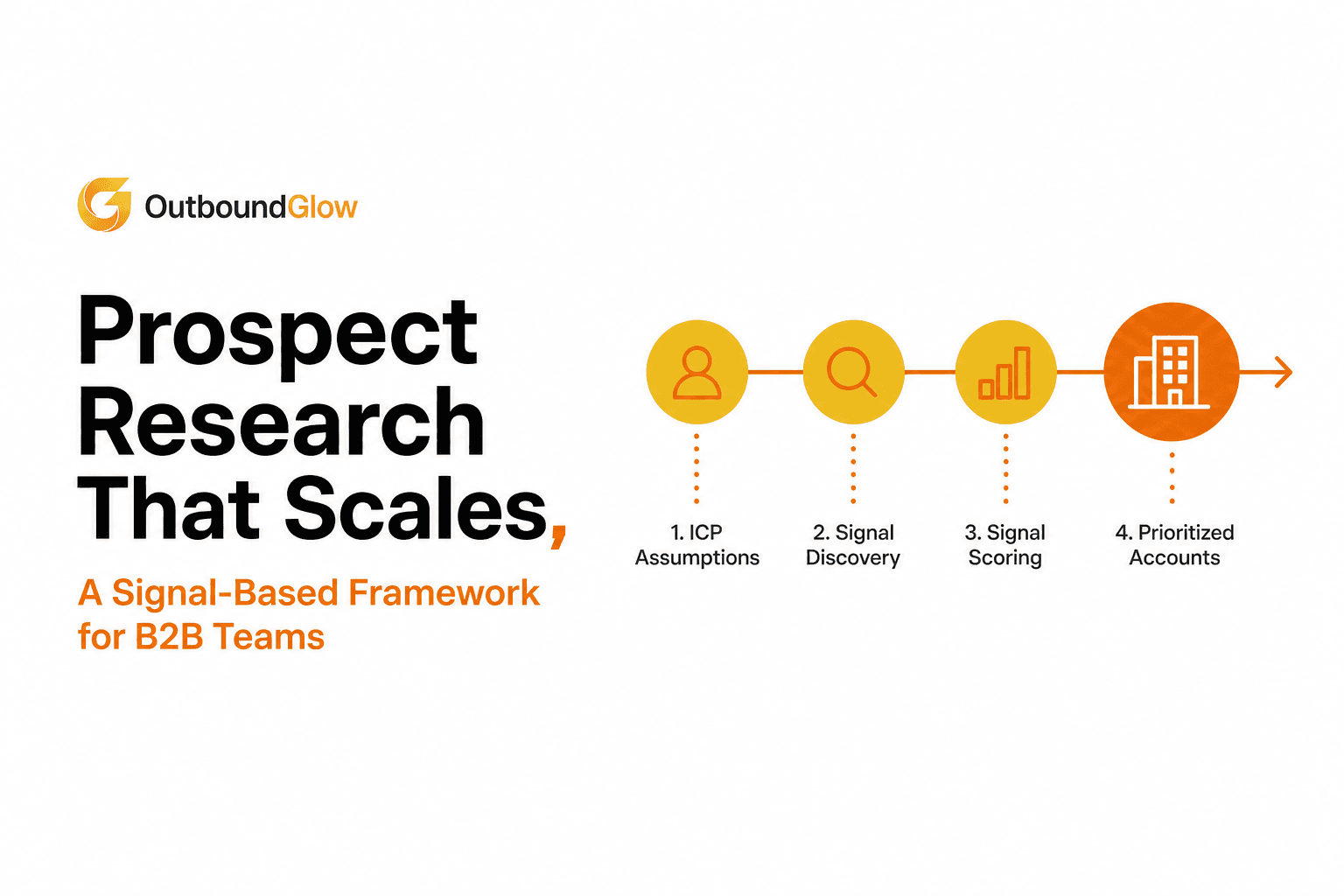
Prospect Research That Scales, A Signal-Based Framework for B2B Teams
Learn prospect research that scales using buying signals, scoring, and messaging inputs to prioritize accounts and personalize outreach without rabbit holes.

How to research prospects for cold email
Learn a fast, practical framework to research prospects, capture fit and intent signals, and turn findings into reusable outreach briefs.