
Bounce Rate Meaning: What It Tells You (and What to Do About It)
Bounce rate meaning explained in plain English, with benchmarks, common mistakes, and a quick checklist to interpret your traffic and fix drop-offs.

You publish a page, drive traffic, and the numbers look promising, until you notice people leave almost immediately. For founders and small B2B teams, that can feel like paying for attention you never really got. The tricky part is that “high bounce rate” is not always bad, and “low bounce rate” is not always good. What matters is what the visit was supposed to achieve. This guide breaks down bounce rate meaning, how it’s calculated, how to interpret it by page type, and a practical checklist to decide what to fix first.
Key Takeaways
Bounce rate is about single-page visits, not “bad traffic” by default.
Judge bounce rate against the page’s job (read, click, sign up, reply), not a universal benchmark.
Use a simple 4-step triage to find whether the issue is intent mismatch, page clarity, speed, or next-step design.
What is bounce rate meaning
Bounce rate meaning is the percentage of visits where someone lands on a page and leaves without taking another action that your analytics counts as “continuing” (for example: viewing a second page, clicking a tracked button, or triggering an engagement event).
In plain terms: a “bounce” is a one-and-done visit. That can signal confusion or low intent, but it can also mean the visitor got what they needed (like reading a phone number, checking pricing, or confirming you’re not a fit).
If you’re working on email-driven traffic, see how Cold Email Deliverability affects whether clicks become real sessions (and not quick exits).
How bounce rate meaning Works in Practice
To make bounce rate actionable, treat it as a diagnostic metric, not a score. Use this step-by-step flow.
Define the page’s “job” in one sentence. Example: “This landing page should get a demo request.” Or: “This blog post should earn 2-3 minutes of reading time and a click to another article.”
Segment by traffic source before judging the number. Compare bounce rate for: branded search, non-branded search, paid ads, referral, and email. A single blended number hides the real story.
Pair bounce rate with one supporting metric.
For content pages: average time on page (or engaged time) and scroll depth.
For landing pages: conversion rate to the next step (form submit, calendar view, pricing click).
For product pages: sign-up start rate or “viewed onboarding” rate.
Classify the bounce as “good” or “bad” using a quick decision table.
Page Type | When a Higher Bounce Can Be OK | When It’s a Problem |
|---|---|---|
Blog post | Time on page is high and readers scroll; they got the answer | Time on page is low and scroll is shallow; headline or intro mismatch |
Landing page | Very narrow campaign with clear “yes/no” fit | Visitors don’t reach the form or CTA; unclear offer or weak next step |
Pricing page | People bounce after copying details and later convert via another channel | No pricing interactions and no next-page views; trust gaps or confusion |
Contact page | They call or email immediately (tracked as an event) | No click-to-call, no email clicks; contact info hard to find |
Concrete example: Suppose your “Cold Email Deliverability” solution page gets 1,000 visits from an email campaign. If bounce rate is 80% but 30% of visitors click “Start free trial” (tracked), then the bounce rate might be inflated by tracking setup. If bounce rate is 80% and CTA clicks are 1%, it’s more likely an intent mismatch (wrong audience) or a clarity issue (unclear promise in the first screen).
If you want to reduce “empty clicks” from outbound, explore AI Email Personalization as a way to better match message to recipient intent, which often reduces fast exits after the click.
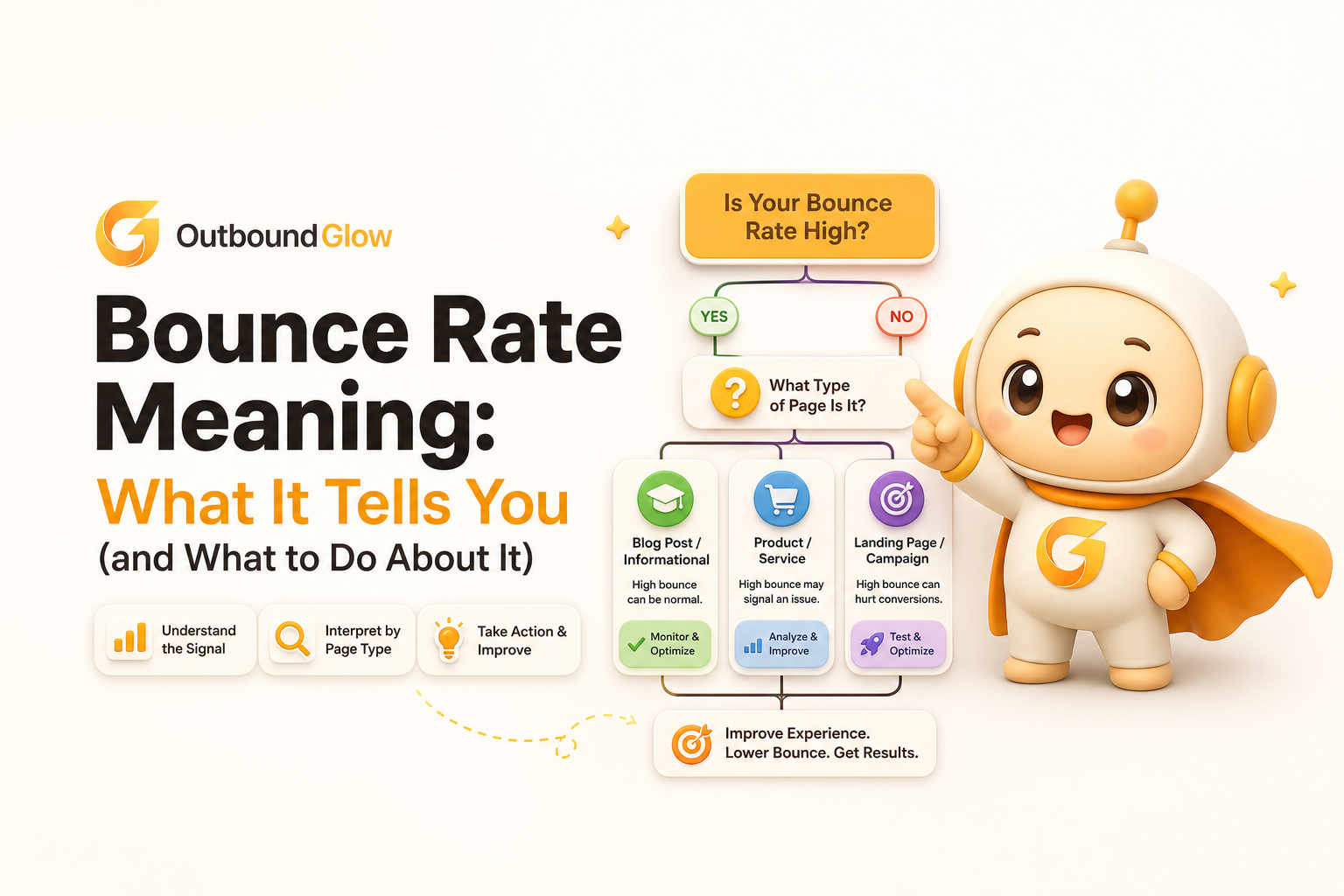
A simple decision flow for interpreting bounce rate by page type and intent.
Key Benefits of bounce rate meaning for B2B Founders
1) Faster “message-market” feedback without waiting for pipeline
Bounce rate gives you an early signal on whether the promise that brought people in matches what they see. If a page’s bounce spikes right after you change a headline, positioning, or ad copy, you get feedback in hours, not weeks.
Mini-checklist: When bounce rises, verify (1) headline matches the ad/email, (2) first screen states who it’s for, (3) one clear next step exists.
2) A clean way to prioritize what to fix first
Founders often debate redesigns. Bounce rate helps you rank pages by “leak severity.” Start with pages that have (a) high traffic, (b) high bounce, and (c) low conversions to the next step.
Priority formula: Fix first = (Traffic volume) x (Bounce rate) x (Business value of the page).
3) Better spend efficiency for ads and outbound clicks
If you pay for clicks (ads) or spend time earning clicks (cold email), bounce rate helps you detect wasted visits. A small improvement on a high-traffic page can reduce cost per lead without increasing traffic.
Benchmarking tip: Compare bounce rate by source. If email traffic bounces 2x higher than organic search, the issue is usually expectation mismatch, not page design.
4) Stronger conversion paths by designing “the second step”
Many B2B pages fail because they answer the first question but don’t guide the next action. Bounce rate highlights where visitors stop, so you can add the right second step: a comparison table, a short proof section, or a CTA that matches readiness.
Second-step menu (pick one): “See pricing,” “Watch 90-second demo,” “Check deliverability score,” or “Read a case study.”
If your goal is to turn more sessions into replies and demos, see Cold Email Outreach Analytics to connect clicks to outcomes and spot where drop-offs happen.
Common Mistakes Founders Make with bounce rate meaning
These are the most common ways teams misread bounce rate and make the wrong product or marketing decisions.
Chasing a universal “good bounce rate.” A blog post that fully answers a question can have a higher bounce and still be doing its job. A landing page meant to capture demos usually cannot.
Looking at bounce rate without engagement or conversions. Bounce alone can’t tell you if visitors were satisfied. Always pair it with one outcome metric (CTA click, form submit, engaged time, or scroll depth).
Ignoring mobile experience. A page can look fine on desktop but be hard to read or navigate on a phone, especially if the CTA is below the fold. Compare bounce rate on mobile vs desktop before changing copy.
Fixing the page when the real issue is intent. If outbound emails promise “verified leads” but the landing page is about “deliverability monitoring,” people will bounce quickly. Align the promise, not just the design.
Frequently Asked Questions
What is a good bounce rate?
A “good” bounce rate depends on the page’s purpose and traffic source. Content pages can be fine with a higher bounce if readers spend time and scroll. Landing pages built to capture leads usually need a lower bounce and a healthy click or form completion rate.
Does bounce rate mean people hate my content?
Not necessarily. Bounce rate simply means the session ended after one page or without a tracked engagement action. If time on page is strong, your content may be satisfying the search. If time is low, it can signal mismatch, confusing layout, or slow load.
How is bounce rate different from exit rate?
Bounce rate focuses on sessions that end after a single page interaction. Exit rate is the percentage of sessions that end on a specific page, even if the visitor viewed multiple pages first. Exit rate is common on pricing or contact pages and is not automatically negative.
How can I reduce bounce rate quickly without a redesign?
Start with three fast changes: make the first screen clearly state who it’s for and what problem it solves, add one obvious next step (a single primary button), and ensure the page is easy to read on mobile. Then re-check bounce rate by traffic source to confirm the improvement is real.
Conclusion
Bounce rate meaning is simple: one-and-done visits. The value comes from interpreting it in context, by page type and traffic source, and pairing it with one supporting metric like engaged time or conversion rate. Use the decision table and the triage checklist to decide whether you have an intent problem, a clarity problem, or a next-step problem.
If you want to explore how this works in practice for outbound clicks, see how Outbound Glow helps teams protect deliverability and improve the quality of sessions that come from cold email campaigns.

Written by Leah Nguyen
Read Next
View all
Improve Email Deliverability for Cold Outreach With a Weekly System That Protects Domain Health
Improve email deliverability for cold outreach with a weekly scorecard, ramp plan, and safe personalization to protect domain health.

Test Domain Health Before Scaling Cold Email With a 72-Hour Micro-Send Protocol
Learn how to test domain health before scaling cold email using a 72-hour micro-send protocol, go/no-go thresholds, and fix paths.
Domain Health Check for Cold Email, A Weekly Scorecard That Catches Trouble Early
A weekly domain health check scorecard for cold email: what to measure, safe thresholds, and a fix-first playbook when deliverability drops.